

Memory Aids for Dementia: 11 Tools That Really Help
Forgetting where the keys are is frustrating. Forgetting why you walked into a room can be unsettling. But for someone living with dementia, these moments can happen repeatedly—and ordinary daily tasks can suddenly become much harder.
The good news is that memory aids for dementia do not have to be complicated or expensive. Sometimes, a large calendar on the wall, a clearly labeled drawer, or a simple reminder board can make a meaningful difference.
And here is the surprising part: the best memory aid is not always the most advanced one. The best aid is often the one that fits naturally into the person’s existing routine.
What Are Memory Aids for Dementia?
Memory aids for dementia are tools, visual cues, written reminders, or technologies that help a person remember information, follow routines, complete tasks, or communicate more easily.
They work as an external support rather than asking the person to remember everything internally.
For example, instead of repeatedly asking, “What am I supposed to do this morning?”, a person might have a simple daily board showing:
Breakfast → Medication → Walk → Lunch → Rest
That small change can reduce confusion and make the day feel more predictable.
11 Memory Aids for Dementia That Can Really Help
1. Reminder Clocks
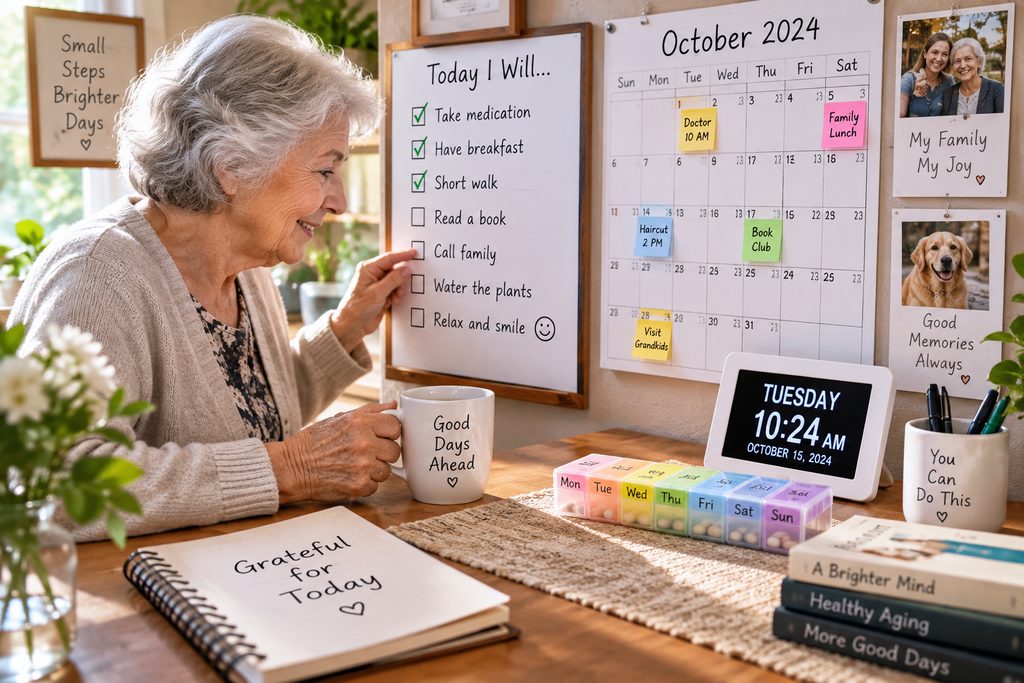
A reminder clock can display more than just the time. Some models show the day, date, or time of day in large, easy-to-read text.
For people who frequently lose track of the day, this can provide an immediate visual reference.
The key is simplicity. Too many screens, buttons, or notifications can create another problem instead of solving one.
2. Large Calendars and Daily Planners
A large calendar placed somewhere visible can become one of the simplest memory aids for dementia.
Use it for appointments, visitors, important events, or recurring activities.
A daily planner can go one step further by breaking the day into manageable sections.
Instead of remembering ten things at once, the person only needs to focus on what comes next.
3. Medication Organizers
Medication routines can become difficult when someone is unsure whether they have already taken a dose.
A clearly organized medication system can provide a visual reminder of what has been prepared and what remains.
For safety, medication systems should be chosen and supervised according to the person’s needs and the recommendations of their healthcare professional or caregiver.
4. Memory Boards
A memory board can act like a visual “home base.”
It might include:
- Today’s date
- Day of the week
- Weather
- Upcoming appointments
- Names of visitors
- A simple daily schedule
For memory aids for dementia patients, personalization matters. A board filled with familiar names and photographs may be more useful than a generic board.
5. Checklists and Written Reminders
Simple checklists are often overlooked.
A bathroom checklist might say:
Toilet → Wash hands → Brush teeth → Turn off light
A leaving-the-house checklist might say:
Keys → Phone → Wallet → Jacket
These are practical memory aids for dementia because they turn an invisible memory task into a visible sequence.
6. Memory Books and Photo Albums
A memory book can combine photographs with names, places, and short descriptions.
For example:
“Sarah — daughter — lives in Boston.”
“John — brother — loves fishing.”
This can provide useful prompts during conversations and help connect familiar faces with information.
These are especially useful memory aids for dementia sufferers when they are personalized rather than overloaded with too many photographs.
7. Labels and Visual Cues
Labels can make the environment easier to understand.
A drawer might say:
SOCKS
Another might say:
TOWELS
Pictures can also be added when appropriate.
The goal is not to make the home look like a classroom. The goal is to quietly answer questions before they need to be asked.
8. Shopping and Routine Lists
A familiar shopping list can reduce the mental effort required to remember several items.
Routine lists can work the same way.
For example:
Morning Routine
- Get dressed
- Eat breakfast
- Take medication
- Check calendar
- Prepare for the day’s activity
These simple memory aids for dementia can make familiar activities easier to repeat independently.
9. Electronic Reminders
Technology can provide additional support through phones, tablets, digital calendars, alarms, and reminder applications.
However, technology is only useful when the person can comfortably use it.
This is where memory aids assistive technology can be helpful: the device can provide reminders without requiring the person to remember every detail themselves.
{ → Apps for people with dementia }
10. Communication Cards and Boards
Memory problems can affect communication too.
A person may know what they want to say but struggle to find the right word or remember someone’s name.
Simple communication cards, photographs, written prompts, or yes/no choices can reduce that pressure.
This is why memory and communication aids for people with dementia should be considered together rather than treated as completely separate needs.
11. Personalized Daily Routine Boards
A personalized routine board brings several memory aids for dementia together in one place.
It might show:
Today is Monday
Morning: Breakfast → Medication → Shower
Afternoon: Lunch → Rest → Family visit
Evening: Dinner → Television → Bedtime
The board should reflect the person’s actual routine—not an idealized schedule that is difficult to follow.
Memory Aids for Early Dementia: Start Simple
People with early dementia may still manage many everyday activities independently.
That means memory aids for early dementia should support independence rather than unnecessarily taking control away.
A person who can still use a smartphone might prefer digital reminders.
Someone who prefers paper may do better with a calendar and checklist.
Someone who responds strongly to visual information might benefit from photographs, labels, or a memory board.
The insight is simple: do not choose the aid first. Choose the person’s need first.
Then select the simplest tool that solves that particular problem.
Choosing Memory Aids for Dementia Patients
When choosing memory aids for dementia patients, ask five practical questions:
What does the person frequently forget?
Is it appointments, names, medication routines, household tasks, or where things belong?
Can they read the information easily?
Large text and strong visual organization may be more useful than a complicated device.
Do they already use technology?
If not, introducing several new apps at once may create frustration.
Where does the problem happen?
Put the aid where the memory problem occurs. A kitchen checklist belongs in the kitchen—not hidden inside a notebook.
Can the person use it independently?
If the answer is yes, the aid may provide more than memory support. It may also help preserve confidence and independence.
Dementia Aids for Memory: Before and After
Imagine someone repeatedly asking what is happening that afternoon.
Before:
They ask several times, become frustrated, and depend on a caregiver for the answer.
After:
A clearly visible daily board says:
Tuesday — Doctor appointment at 2:00 PM
The question may still come up. But now there is an immediate visual reference.
That is the real value of dementia aids for memory.
They simply make important information easier to find.
Make Memory Aids Work Better at Home
The most effective memory aids for dementia are usually:
- Visible — placed where they are needed.
- Simple — showing only useful information.
- Consistent — used in the same way every day.
- Personal — connected to familiar people and routines.
- Flexible — changed when the person’s needs change.
Avoid putting ten different reminders around the house.
One clear reminder in the right place can be more useful than five confusing ones.
For caregivers, the goal is not to constantly correct or test someone’s memory. The goal is to create an environment where important information is easier to access.
{→ Useful distraction techniques for dementia caregivers }
The Best Memory Aid May Be the Simplest One
When people search for memory aids for dementia, they may expect to find a sophisticated device or expensive technology.
Sometimes the answer is much simpler.
A calendar.
A photograph.
A label.
A checklist.
A familiar routine.
A small board on the wall.
The difference comes from matching the tool to the person and the specific problem.
And that is what makes memory aids for dementia so useful: they move some of the remembering from the person’s mind into the environment around them.
If you are helping someone with dementia, you do not need to transform the entire home today.
Start with one recurring problem. Choose one simple aid. Put it where it will actually be used. Then see what changes.
That small first step can be the beginning of a much easier daily routine.
{→ Alzheimer’s memory aids }
Frequently Asked Questions
What are some helpful tools for dementia patients?
Helpful tools can include large calendars, reminder clocks, medication organizers, memory boards, checklists, labels, photo books, electronic reminders, and communication boards. The best option depends on the person’s specific needs and abilities.
What are the best memory aids for someone with dementia?
There is no single best aid for everyone. Simple, visible, personalized tools such as calendars, routine boards, checklists, and memory books are often useful starting points.
What are examples of external memory aids for dementia?
Examples include written reminders, calendars, labels, checklists, memory boards, photographs, electronic reminders, and daily planners.
What memory aids are useful for early dementia?
Memory aids for early dementia can include smartphone reminders, calendars, planners, checklists, labeled storage, and personalized routines that help maintain independence.
How can I help a dementia patient with memory?
Identify one recurring difficulty and create a simple external reminder for it. Keep the information visible, consistent, easy to understand, and connected to the person’s normal routine.
Are memory boards helpful for dementia patients?
They can be helpful when they contain simple, relevant information such as the date, daily schedule, appointments, photographs, and familiar names. A personalized board is generally more useful than one containing too much information.
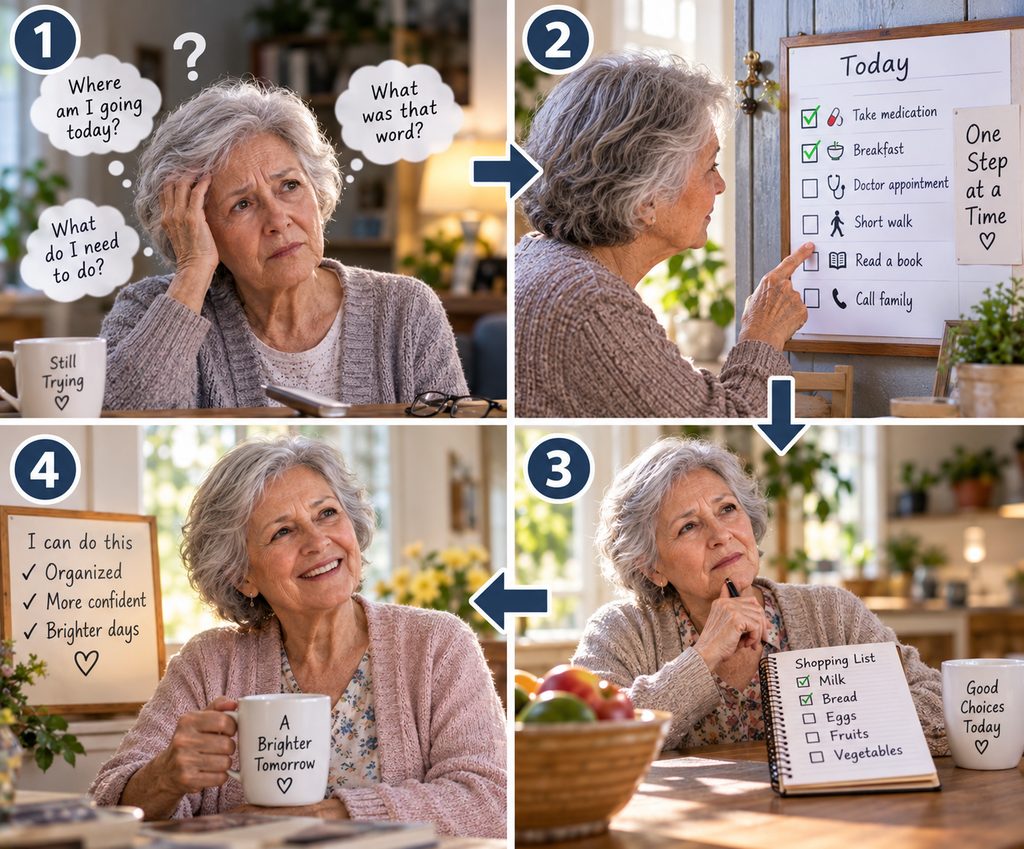
But memory support doesn’t always end with calendars and reminders.
If you’ve been wondering about brain fog, forgetfulness, or those moments when a familiar word just won’t come, there are other ideas worth exploring.
One of them is Phytomem One, which introduces an interesting concept called “Toxic Brain Shards.”
If that idea makes you curious, you can explore it further below.