


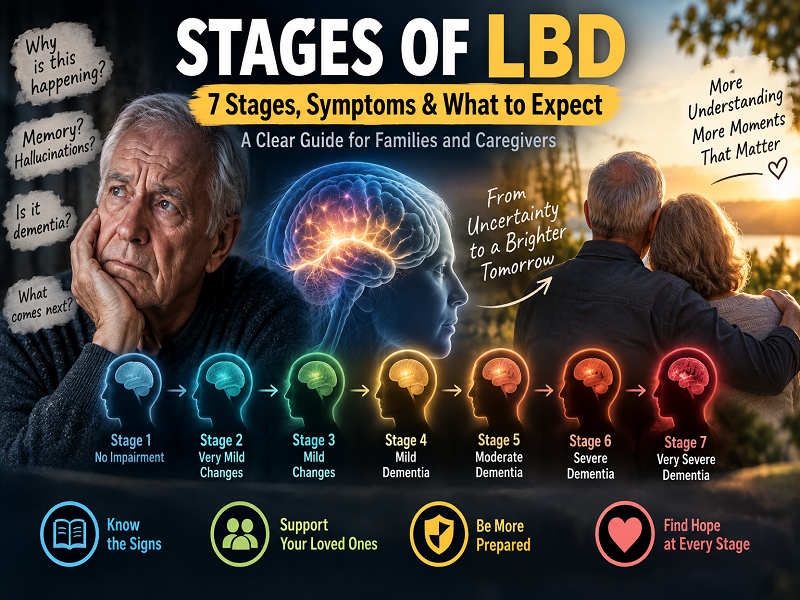
Stages of LBD: 7 Stages, Symptoms, and What to Expect
When someone you love is diagnosed with Lewy body dementia, it is natural to wonder what happens next. You may search for stages of LBD hoping to find a simple timeline that tells you exactly what to expect.
Unfortunately, LBD does not always work that way.
The condition can affect thinking, movement, sleep, attention, behavior, and alertness, sometimes in ways that seem to change from one day to the next. Understanding the stages of LBD can still be helpful, but the goal is not to put a person into a rigid box. It is to recognize changes early and understand what kind of support may become important.
What Are the Stages of LBD?
There is an important detail to understand before looking at the stages of LBD: Lewy body dementia does not have one universally accepted official staging system that predicts exactly how the disease will progress.
A seven-stage framework is often used to help describe the general progression of dementia. It can give families a useful reference point, but people with LBD do not necessarily experience every stage in exactly the same way or at the same speed.
That is one of the most important insights about stages of LBD.
The number matters less than the person’s actual abilities.
A person may have significant movement problems while still communicating well. Another person may have major fluctuations in attention before needing much physical assistance. Looking at the whole picture is more useful than relying on a stage number alone.
The 7 Stages of LBD
The following framework can help families understand how symptoms and daily care needs may change over time.
Stage 1: No Noticeable Impairment
In the earliest period, there may be little that appears unusual.
The person may continue working, managing finances, driving, socializing, and handling everyday responsibilities normally. Looking back later, however, family members may remember subtle changes in sleep, attention, mood, or alertness.
These early clues can be easy to dismiss because they may resemble ordinary aging.
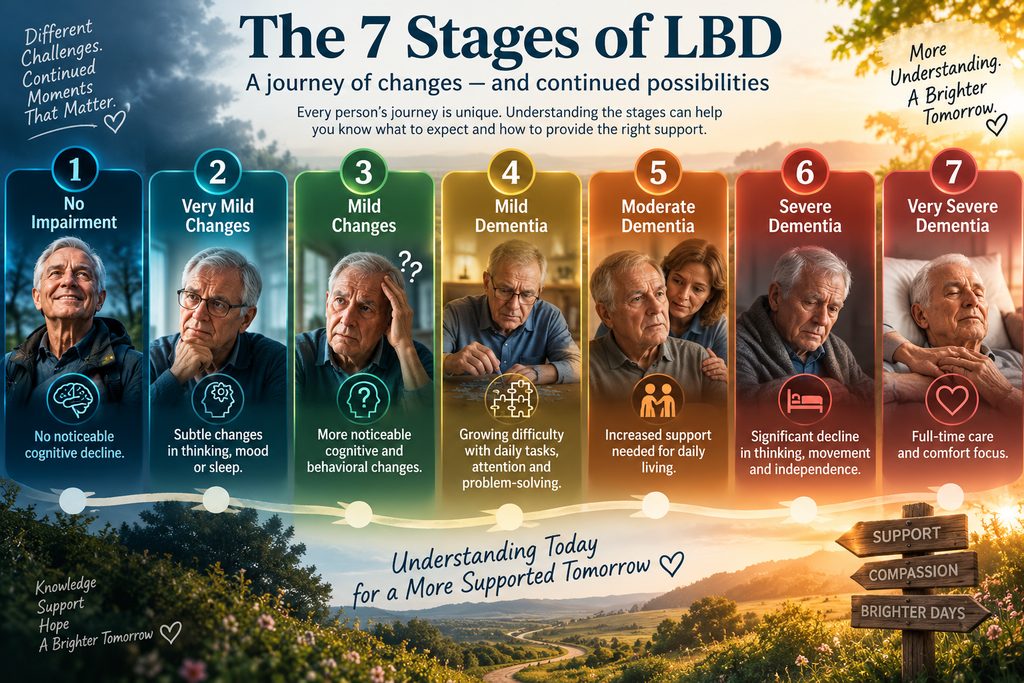
Stage 2: Very Mild Changes
Small changes may begin to appear.
Someone might occasionally lose their train of thought, become distracted during conversations, or have more difficulty organizing complicated tasks. Sleep disturbances or changes in movement may also attract attention.
At this point, the stages of LBD can be especially difficult to recognize because the changes may not yet interfere significantly with independence.
Stage 3: Mild Cognitive Changes
Changes become more noticeable in everyday life.
A person may have difficulty concentrating, planning, handling multiple tasks, or understanding visual information. Changes in movement, sleep, alertness, or perception may become more apparent.
Visual hallucinations can occur in LBD and are an important symptom to discuss with a healthcare professional.
For families trying to describe stages of LBD, this is often the point where “something has changed” becomes much harder to ignore.
{→ 7 stages of lewy body dementia symptoms }
Stage 4: Mild Dementia
At this stage, independence may begin to decline.
The person might need reminders or assistance with medications, appointments, finances, cooking, transportation, or other complicated activities. Movement and balance problems may also interfere with daily routines.
Instead of asking only, “What stage are they in?” caregivers can ask:
What can they still do safely on their own?
That question provides much more useful information for planning everyday care.
Stage 5: Moderate Dementia
The need for support usually becomes greater.
A person may have increasing difficulty with everyday tasks, communication, judgment, and orientation. Walking and balance may also require closer attention.
Caregivers may become responsible for medications, meals, appointments, personal care, and safety.
This is where understanding the stages of LBD can become practical rather than simply informational. Knowing that greater support may be needed allows families to prepare before a crisis forces them to react.
{ → useful distraction techniques for dementia caregivers }
Stage 6: Severe Dementia
Cognitive and physical limitations may now significantly affect daily life.
The person may need substantial help with dressing, bathing, eating, walking, communication, and other activities. Fluctuations in alertness can continue, while hallucinations or other behavioral symptoms may also require careful management.
Movement problems can increase fall risk, and changes involving automatic body functions may create additional challenges.
At this point, the stages of LBD are less about a label and more about understanding the person’s changing care needs.
Stage 7: Very Severe Dementia
The final stage involves a high level of dependence.
Communication may become extremely limited. Mobility can be severely affected, and the person may require extensive or complete assistance with basic activities.
Swallowing difficulties and other physical complications may also become important concerns.
In the later stages of LBD, care often shifts toward comfort, dignity, safety, and quality of life rather than maintaining independence at all costs.
What Are the Early Stages of LBD Like?
The early stages of LBD can look different from what families expect when they hear the word “dementia.”
Memory loss may not be the first obvious symptom. Changes in attention, alertness, visual-spatial abilities, sleep, movement, mood, or perception can appear early.
One person might seem confused at certain times but relatively clear later. Another may develop noticeable movement or sleep problems before cognitive changes become obvious.
That unpredictability is one reason families should pay attention to patterns, not just isolated incidents.
Keeping a simple record of unusual symptoms, changes in sleep, hallucinations, falls, or periods of confusion can help healthcare professionals understand what is happening.
{ → Memory aids for dementia }
What Is the Progression of Lewy Body Dementia?
One of the biggest challenges in understanding stages of LBD is that progression may not look like a straight line.
LBD is known for fluctuations in attention and alertness. Someone may have a surprisingly good morning and then struggle considerably later in the day. This can make families wonder whether the disease is actually progressing.
Over a longer period, however, there may be an overall decline in thinking, movement, communication, and independence.
The key is to distinguish a temporary fluctuation from a sustained change in abilities.
A sudden change should also be discussed with a healthcare professional rather than automatically being blamed on dementia. Infection, medication effects, dehydration, pain, or other medical problems can cause abrupt changes in behavior or alertness.
What Are the Signs That LBD Is Getting Worse?
Families often notice progression through everyday activities before they notice a major change in a diagnostic label.
Signs may include:
- Needing more help with bathing or dressing
- Increasing difficulty walking or maintaining balance
- More frequent falls
- Greater difficulty communicating
- More supervision needed for medications or meals
- Increasing confusion or fluctuations in alertness
- Greater difficulty managing ordinary household tasks
- Increasing dependence on caregivers
These changes can help families understand the stages of LBD in a much more meaningful way.
The important question is not simply whether a symptom exists. It is whether the symptom is beginning to interfere with safety, independence, comfort, or quality of life.
What Happens in the End Stages of LBD?
The end stages of LBD can involve severe cognitive and physical impairment.
A person may have very limited mobility and require extensive assistance with personal care. Communication can become difficult, and swallowing problems may develop.
Eating, repositioning, bathing, toileting, and maintaining comfort may require hands-on support.
This can be an emotionally painful transition for families. But there is also an important shift in perspective: care is no longer about trying to make the person function exactly as they did before.
It becomes about helping them feel safe, comfortable, respected, and cared for.
How Long Can You Live With Lewy Body Dementia?
There is no single life expectancy that applies to everyone with LBD.
The National Institute on Aging notes that LBD lasts an average of about five to seven years from diagnosis to death, although the range can be considerably broader. Individual outcomes can vary depending on age, overall health, symptoms, complications, and other factors.
This is another reason not to treat the stages of LBD as a countdown clock.
Being described as being in a particular stage does not tell a family exactly how long the person has left.
What Is the One-Year Rule for Lewy Body Dementia?
The “one-year rule” is mainly used to help distinguish dementia with Lewy bodies from Parkinson’s disease dementia.
In simplified terms, doctors consider the timing of cognitive and movement symptoms when making the diagnosis. If dementia symptoms appear before or around the same time as parkinsonian symptoms, dementia with Lewy bodies may be considered. If established Parkinson’s disease occurs for more than a year before dementia develops, Parkinson’s disease dementia may be considered.
It is not a rule that says someone will move through the stages of LBD within one year.
What Can Caregivers Do as LBD Progresses?
The most useful approach is to focus on what has changed recently.
Ask:
What can this person still do independently?
What has become difficult or unsafe?
What support would make today easier?
That approach turns knowledge about the stages of LBD into something practical.
Early on, a few reminders or environmental adjustments may be enough. Later, caregivers may need to coordinate medications, personal care, mobility assistance, appointments, and additional support.
{→ activities for seniors with dementia}
Final Thoughts on the Stages of LBD
Learning the stages of LBD can give families a framework for understanding a complicated condition, but it should never become a rigid prediction of the future.
LBD does not follow exactly the same path for every person. Symptoms can fluctuate, different problems can appear at different times, and the level of support someone needs may change gradually or unexpectedly.
The most helpful thing you can do is watch the person rather than the number.
When you understand what has changed, recognize the signs of increasing care needs, and prepare for the next challenge before it becomes an emergency, the road ahead can feel much less overwhelming.
And that is really the value of learning the stages of LBD: not predicting every step, but helping families feel more prepared for the ones that come next.

A Different Question Worth Asking
Understanding the stages of LBD helps families recognize changes. But it also leads to a broader question:
What about the small memory problems that happen long before anyone is thinking about dementia?
Forgetting a name. Losing a word halfway through a sentence. Walking into a room and forgetting why you went there.
These everyday moments have made many people more interested in how memory and brain health may be supported as they get older.
One concept you may come across is “Toxic Brain Shards,” a different way of thinking about what may affect everyday cognitive function.
If you’re curious about the idea, you can explore it here.