



7 Stages of Lewy Body Dementia
If you’re caring for someone with Lewy body dementia, one of the hardest questions can be: What happens next?
The 7 stages of Lewy body dementia are sometimes used as a framework for describing how symptoms and care needs may change over time. But there is an important point to understand first: Lewy body dementia does not have formally defined clinical stages like Alzheimer’s disease does.
The seven-stage framework is a general guide, not an official medical staging system or a fixed timeline.
For families trying to understand the 7 Stages of Lewy Body Dementia, knowing how symptoms and care needs may change can make the journey feel a little less uncertain.
What Is Lewy Body Dementia?
Lewy body dementia (LBD) is a progressive brain disorder associated with abnormal deposits of alpha-synuclein called Lewy bodies.
LBD can affect attention, thinking, movement, sleep, behavior, vision, and automatic body functions. Unlike typical early Alzheimer’s disease, memory loss does not always come first.
Changes in attention, alertness, movement, sleep, or visual perception may be more noticeable early on.
National Institute on Aging — Lewy Body Dementia
Understanding these symptoms can provide important context before looking more closely at the 7 Stages of Lewy Body Dementia.
The 7 Stages of Lewy Body Dementia
These stages should be viewed as a general progression framework. LBD does not necessarily follow this exact sequence, and people can experience symptoms differently.
Stage 1: No Noticeable Cognitive Decline
There may be little obvious impairment in thinking or everyday independence. Early changes can be subtle and may involve sleep, mood, attention, vision, or other functions before dementia becomes apparent.
Stage 2: Very Mild Cognitive Changes
Small changes in concentration, attention, organization, or mental processing may begin. The person can usually continue everyday activities independently, and the changes may easily be mistaken for normal aging or tiredness.
Stage 3: Mild Cognitive and Functional Changes
Problems with attention, planning, reasoning, multitasking, or visual-spatial abilities may become easier to notice.
Movement symptoms or visual hallucinations may also appear. However, the combination and timing of symptoms can vary considerably.
Stage 4: Mild Dementia
Cognitive changes may begin interfering with everyday tasks. The person may need help with medications, finances, appointments, cooking, or other complex activities.
Hallucinations, delusions, anxiety, depression, or paranoia can also occur.
Stage 5: Moderate Dementia
Independence becomes increasingly difficult. Regular assistance may be needed with daily routines, medication, communication, mobility, or personal care.
Balance problems, falls, stiffness, swallowing difficulties, constipation, and dizziness may also become more significant.
At this point in the 7 Stages of Lewy Body Dementia, families may notice that the person’s need for daily support has changed significantly.
Stage 6: Severe Cognitive Decline
Cognitive and physical difficulties may substantially limit independence.
Extensive assistance may be needed with personal care, meals, medications, communication, mobility, and safety.
Stage 7: Very Severe or Late-Stage LBD
At the advanced end of this framework, a person may become highly dependent on others for daily care.
Communication, movement, eating, swallowing, and personal care can become increasingly difficult. Some people eventually require complete assistance.
The later 7 Stages of Lewy Body Dementia can involve substantial changes in both cognitive and physical abilities, although each person’s experience can still be different.
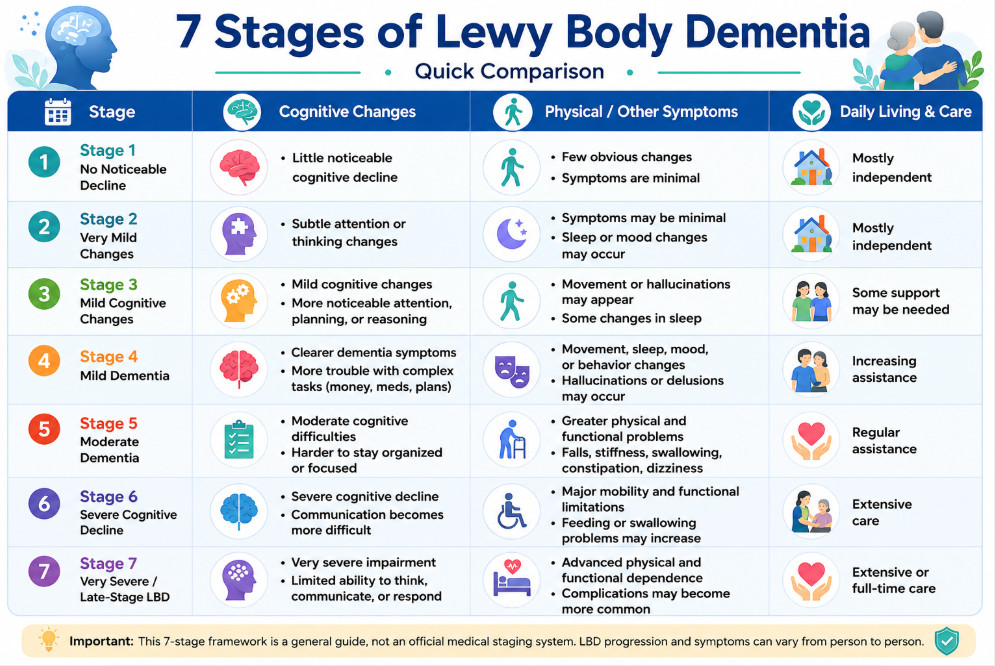
7 Stages at a Glance
A simple visual summary can make the progression easier to understand:
Important: This table is a general guide, not a diagnostic checklist. LBD symptoms can overlap, fluctuate, and appear at different points in different people.
For this reason, the 7 Stages of Lewy Body Dementia should be used as a general framework rather than as a precise way to predict exactly what will happen next.
Is There a Timeline for the 7 Stages?
There is no fixed timeline for progressing through the seven stages.
The rate of LBD progression can vary greatly. The Lewy Body Dementia Association reports a typical lifespan of about five to seven years after diagnosis, but this should not be treated as an individual prediction.
Progression can also be uneven. A person may have noticeable changes followed by periods of relative stability, while fluctuations in attention and alertness can make abilities seem very different at different times.
This is one reason why the 7 Stages of Lewy Body Dementia cannot be used as an exact timeline for every individual.
A sudden increase in confusion, hallucinations, behavioral changes, or physical decline should not automatically be assumed to mean that the person has simply reached the next stage.
Medical causes and medication reactions can also contribute to sudden changes.
Lewy Body Dementia Life Expectancy
Searching for Lewy body dementia stage 6 life expectancy or stage 7 life expectancy can understandably lead families to want a precise answer.
Unfortunately, a stage number cannot tell you exactly how long someone will live.
Life expectancy varies with factors such as overall health, age, disease severity, complications, and the individual’s rate of progression.
The commonly cited five-to-seven-year figure is a general population estimate, not a countdown for one person.
For families following the 7 Stages of Lewy Body Dementia, changing care needs and quality of life are often more useful things to focus on than trying to predict an exact timeline.
What Symptoms Can Change Across the Stages?
LBD can involve several groups of symptoms:
⦁ Cognitive: attention, reasoning, planning, visual-spatial abilities, and memory.
⦁ Physical: slowed movement, stiffness, tremor, balance problems, falls, and swallowing difficulties.
⦁ Hallucinations and behavior: visual hallucinations, delusions, paranoia, anxiety, and depression.
⦁ Sleep: sleep disturbances, including REM sleep behavior disorder.
⦁ Automatic body functions: dizziness, constipation, urinary problems, and other autonomic changes.
Not everyone develops every symptom, and symptoms do not necessarily appear in the same order.
This variation is important to remember when looking at the 7 Stages of Lewy Body Dementia, because two people may experience the disease differently.
What Should Caregivers Focus On?
Instead of asking only, “What stage are they in?”, a more practical question is:
“What has changed, and what support does this person need now?”
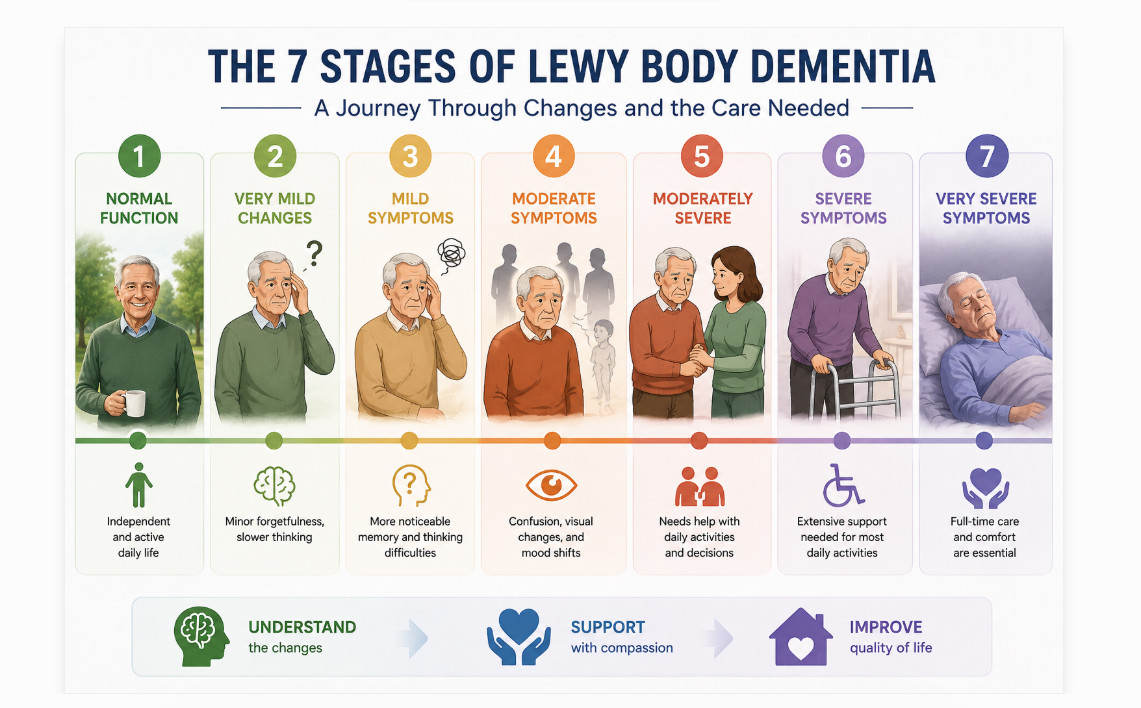
Early support may involve reminders, transportation, organization, or help with complex tasks.
As LBD progresses, caregivers may need to provide more assistance with medications, mobility, meals, personal care, and safety.
This practical approach can be especially helpful when navigating the 7 Stages of Lewy Body Dementia, because care needs may change even when progression does not follow a predictable pattern.
Keeping track of changes in thinking, movement, sleep, behavior, and medications can also help healthcare professionals understand how the person’s condition is changing.
Frequently Asked Questions
What is the first symptom most likely to be seen in Lewy body dementia?
There is no single first symptom for everyone. Early changes may involve attention, alertness, vision, sleep, mood, or movement.
Visual hallucinations and cognitive fluctuations are important features of LBD, while prominent memory loss may not appear first.
How bad does Lewy body dementia get?
LBD can eventually cause severe cognitive and physical impairment.
In advanced disease, a person may require extensive or complete assistance with everyday activities and personal care.
This is why understanding the possible progression described by the 7 Stages of Lewy Body Dementia may help families prepare for changing support needs.
Is Lewy body dementia worse than Alzheimer’s?
There is no simple “better” or “worse” answer. The conditions have different symptom patterns.
LBD can prominently involve hallucinations, cognitive fluctuations, sleep disorders, and movement problems, while Alzheimer’s disease more typically begins with memory-related difficulties.
What can be mistaken for Lewy body dementia?
Early LBD can resemble Alzheimer’s disease and other neurological or psychiatric conditions because symptoms can overlap.
An accurate medical evaluation is important when cognitive, movement, sleep, mood, or behavioral changes appear.
Final Takeaway
The 7 stages of Lewy body dementia can help families understand possible progression from subtle changes to advanced care needs.

But they are not an official clinical staging system or a fixed timeline. LBD can affect thinking, movement, sleep, hallucinations, behavior, and other body functions in different ways and at different times.
For that reason, the 7 Stages of Lewy Body Dementia should be viewed as a general guide to possible changes rather than a precise prediction of what will happen to one individual.
The most useful question is not simply “What stage is this?” but “What has changed, and what support is needed now?”
But another question is worth exploring: could a simple 12-minute daily audio routine offer a different way to support mental clarity as we age? The Memory Wave takes an unusual approach—and if you’re curious about how it works and what to consider before trying it, you can learn more here.
Read More
⦁ Stages of Lewy Body Dementia