


Activities for Seniors With Dementia: 9 Ways to Help
Finding the right activities for seniors with dementia can be surprisingly difficult. Something that looks easy may feel frustrating to a person with dementia, while an ordinary activity—looking through family photos, watering a plant, or listening to a favorite song—can create a meaningful moment.
The key is not to find the most impressive activity. It is to find something that feels familiar, comfortable, and worth joining.
Why Activities Matter for Seniors With Dementia
The right activities for seniors with dementia can provide more than entertainment. They can create opportunities for movement, conversation, connection, routine, and a sense of purpose.
For caregivers, this changes the question from “How do I keep them busy?” to something much more useful:
“What could we enjoy doing together today?”
That small shift matters. An activity does not have to improve memory or produce a finished result to be worthwhile. Sometimes, simply sharing a calm and enjoyable experience is the result.
1. Try Fun and Familiar Activities
Some of the easiest fun activities for seniors with dementia begin with things the person already knows.
Look through an old photo album. Listen to a favorite radio program. Watch a familiar movie. Sort postcards or play a simple card game. If they used to enjoy cooking, gardening, sewing, or sports, look for a small version of that interest.
Familiarity reduces the pressure to learn something new.
And remember: the activity does not need to last an hour. Ten enjoyable minutes can be enough.
2. Choose Simple Cognitive Activities
Cognitive activities for seniors with dementia do not have to look like a test or complicated brain-training exercise.
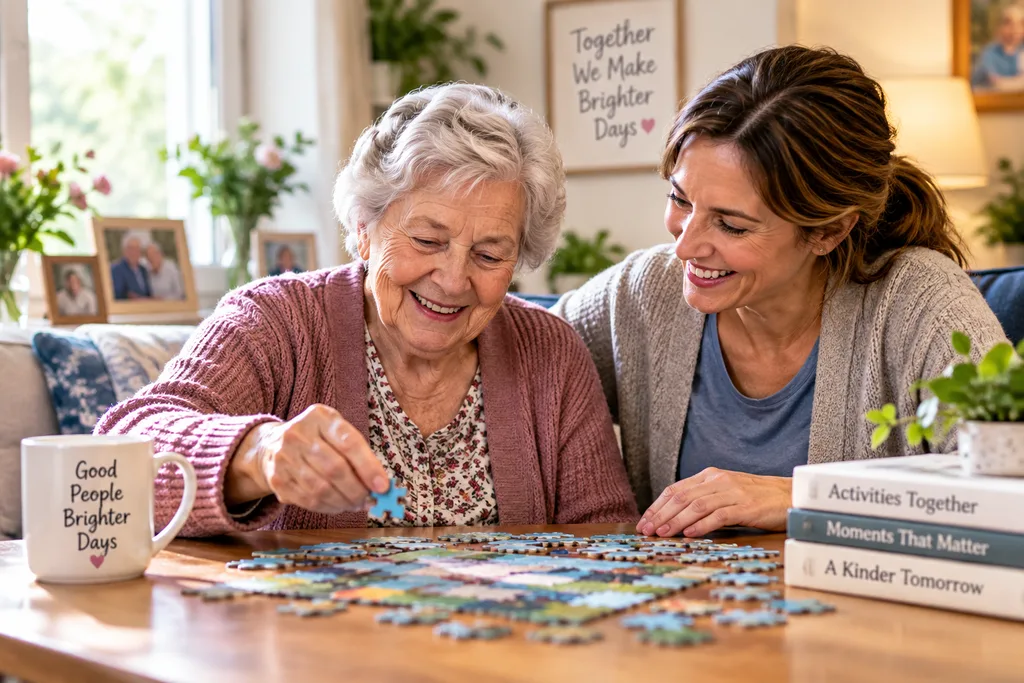
Try matching socks, sorting buttons by color, arranging objects by size, completing a simple puzzle, or identifying familiar household objects.
You can also use photographs to encourage conversation about people, places, or events.
{ → Cognitive activities for seniors}
The important part is to avoid turning the activity into a quiz. If an answer is forgotten, there is no need to correct it repeatedly. Keep the experience relaxed and move on when interest fades.
3. Explore Sensory Activities
Sensory activities for seniors with dementia can offer another way to engage when talking or remembering becomes tiring.
Place a few safe, familiar objects on a table. Let the person feel different textures, smell fresh herbs, look at flowers, or listen to familiar sounds.
A small sensory basket might include soft fabric, a smooth wooden object, a clean towel, or another safe household item.
{ → Sensory activities for seniors with dementia }
Always consider safety. Avoid objects that could be swallowed, cause injury, or create another hazard, especially when supervision is limited.
4. Make Art Without Worrying About the Result
Art can be one of the most flexible activities for seniors with dementia because there is no single correct answer.
Try coloring, painting broad shapes, decorating a greeting card, making a simple collage, or choosing colors together.
For art activities for seniors with dementia, keep the setup simple. Put only a few materials in front of the person rather than presenting an overwhelming collection.
There is no need to ask, “Are you finished?”
Instead, comment on the experience:
“That is a beautiful color.”
The goal is participation, not perfection.
5. Turn Favorite Music Into an Activity
Music can require almost no preparation.
Play songs the person has known for years. Invite them to sing, hum, clap, tap their hands, or simply listen.
You can create a playlist around different periods of their life or songs connected to family memories.
Sometimes a person who struggles to answer a question can still recognize a familiar melody. That is why music can become a gentle way to create connection without demanding a correct response.
6. Add Gentle Movement
Movement does not have to mean a formal workout.
A short walk, gentle stretching, chair exercises, watering plants, or moving around the house can all become part of the day.
The CDC recommends that older adults include physical activity appropriate to their abilities and conditions.
For someone living with dementia, adapt movement to their physical abilities and safety needs. If an activity causes pain, dizziness, unusual shortness of breath, or another concerning symptom, stop and seek appropriate medical advice.
7. Spend Time Outdoors
Some activities for seniors with dementia can be as simple as going outside.
Sit together in the garden. Watch birds. Water flowers. Look at the trees. Smell herbs. Take a short walk around a familiar area.
You do not need to turn it into a gardening project.
Ask the person to water one plant or choose which flowers to look at. The task becomes a reason to spend time together rather than another thing they are expected to accomplish.
8. Use Photos and Memories to Start Conversations
Reminiscence can make activities for seniors with dementia feel personal.
Bring out old photographs, favorite recipes, postcards, familiar objects, or music from earlier years.
Instead of asking, “Do you remember when this picture was taken?” try something easier:
“What do you notice in this picture?”
Or:
“Tell me about this place.”
There is no need to test whether the person’s memory is accurate.
{→ Memory games for dementia}
The conversation itself can be the activity.
9. Let Them Help With Everyday Things
Here is the insight caregivers sometimes miss:
A person with dementia does not always need to be entertained. They may want to feel useful.
Folding towels, pairing socks, setting napkins on the table, sorting utensils, watering plants, or helping prepare a simple snack can all become meaningful activities for seniors with dementia.
{→ 101 things to do with dementia patients }
Instead of saying, “I have an activity for you,” try:
“Would you help me with this?”
That small change can make the moment feel more natural and respectful.
How to Choose the Right Activity
The best activities for seniors with dementia can change from one day to the next.
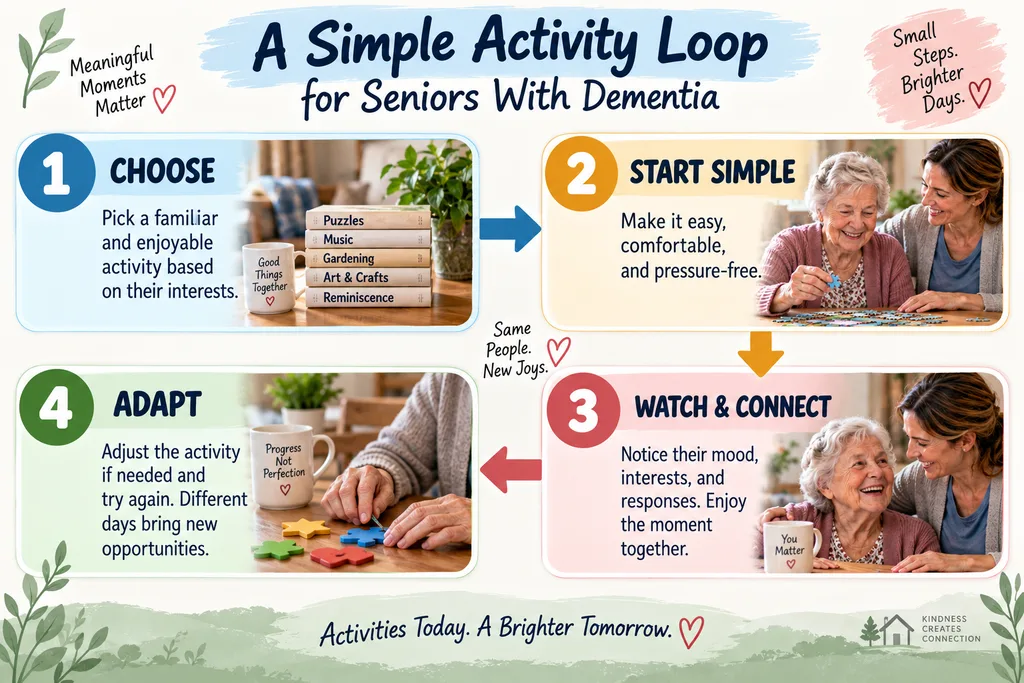
Start with something familiar. Match the activity to the person’s current abilities. Keep instructions short and offer only a few choices.
Most importantly, watch their response.
If they become frustrated, simplify the activity. If they lose interest, stop. If they seem tired, try again another time.
You are not trying to make them complete a task. You are trying to create a positive experience.
What If They Don’t Want to Participate?
This is where many caregivers become frustrated.
But refusing an activity does not necessarily mean the person is being difficult. They may be tired, uncomfortable, confused, or simply not interested at that moment.
Offer two choices instead of giving an order:
“Would you like to listen to music or look at photos?”
If the answer is still no, let it go.
You can try again later.
From “What Do I Do?” to “Let’s Do This Together”
Before, a caregiver might look at the afternoon and think:
After a simpler approach, the answer could be surprisingly ordinary:
A favorite song.
A few family photographs.
Ten minutes watering flowers.
Folding towels together.
A cup of tea and a quiet conversation.
That is the real value of good activities for seniors with dementia. You are not trying to manufacture a perfect day. You are creating small opportunities for comfort, connection, and participation.
Final Thoughts
There is no single perfect activity for every senior with dementia.
Start with what the person already enjoys. Make it easier than you think it needs to be. Follow their mood, celebrate participation, and do not be afraid to stop when something is no longer enjoyable.
The next time you wonder what to do, choose one simple activity and try it together.
Then, when you are ready for more ideas, explore the other practical resources on MemoryAidsGuide.com.
Sometimes, supporting memory function is about looking beyond the activities we do each day. Simple routines, meaningful conversations, movement, and familiar experiences can all have a place in supporting overall brain health.
But as we get older, another question often comes up: are there natural ways to support memory function and brain health alongside a healthy lifestyle?
This is where some people begin exploring carefully selected natural ingredients such as Lion’s Mane, Bacopa, Gotu Kola, Schisandra, and Shilajit. Understanding what these ingredients are, why they are used together, and what a formula built around them is actually intended to support can be an interesting next step.