


What Age a Senior Citizen? 7 Important Ages to Know
At 50, are you a senior?
What about 55? Or 60?
And why does age 62 suddenly appear when people talk about retirement, while 65 seems to be the number everyone associates with being a senior citizen?
If you have ever searched what age a senior citizen is, you may have noticed something frustrating: different websites seem to give different answers.
The reason is simple. There is no single age that makes someone a senior citizen for every situation in the United States.
For everyday conversation, 65 is one of the most commonly recognized senior milestones. But depending on the program, discount, benefit, or organization, the age could be 50, 55, 60, 62, or another threshold.
So instead of memorizing one number, let’s look at what each age actually means.
What Age Is Considered a Senior Citizen?
When people ask what age is considered a senior citizen, they are usually looking for one simple answer.
The closest practical answer is 65.
That’s because 65 has become a major milestone associated with older adulthood in America. It is also closely connected with Medicare eligibility, while the U.S. Census Bureau commonly reports population statistics for people age 65 and older.
But there’s an important distinction.
Being 65 does not automatically mean that every senior discount, benefit, or program will apply to you. Each organization can establish its own eligibility requirements.
{→ when are you considered a senior citizen}
That is why two people can both be 60 years old and have different answers when asking whether they qualify as a “senior.”
One might qualify for a senior discount. Another might not.
The difference is the specific rule being used, not the person’s age changing from one situation to another.
7 Senior Citizen Age Milestones You Should Know
If you’re trying to understand senior citizen age, these seven milestones make the whole subject much easier to understand.
Age 50: Is 50 Considered a Senior Citizen?
Turning 50 does not universally make someone a senior citizen.
However, 50 is sometimes used as the starting point for age-related memberships, communities, discounts, or other programs.
This can create confusion because a business may call a 50-year-old a “senior” for a particular promotion while another organization may not use that definition at all.
So if you’re 50 and wondering what age a senior citizen begins, don’t assume that one company’s policy represents the entire country.
Always check the specific eligibility requirement.
Age 55: Is 55 Considered a Senior Citizen?
Is 55 considered a senior citizen?
Sometimes.
Age 55 is another commonly used threshold by certain businesses, organizations, and communities. Some senior discounts and age-based programs may begin at 55.
But there is no universal rule stating that every American becomes a senior citizen on their 55th birthday.
This is one of the clearest examples of why what age is considered a senior citizen depends on the context.
If you’re looking at a restaurant discount, membership, housing community, or local program, check its individual age requirement.

Age 60: Is 60 Considered a Senior Citizen?
Is 60 considered a senior citizen?
It can be, depending on the program.
Some organizations use 60 as an eligibility threshold for services or activities aimed at older adults. Others may choose 55, 62, or 65.
So someone who is 60 may reasonably be described as a senior in some situations, while not meeting the age requirement for another senior benefit.
If you’re searching what age a senior citizen is because you want to know whether you qualify for something, the name of the program matters just as much as your age.
Age 62: Why Does 62 Matter?
Age 62 is particularly important because it is the earliest age at which eligible workers can generally begin receiving Social Security retirement benefits.
That doesn’t mean 62 is the official senior citizen age.
It simply means Social Security has a specific retirement-benefit rule associated with that age.
This distinction is easy to miss. A retirement benefit age and a social definition of “senior citizen” are not necessarily the same thing.
If you’re planning retirement, it’s therefore better to look at the actual Social Security rules rather than assume that reaching 62 automatically changes every other age-based benefit.
Age 65: The Big Senior Milestone
Now we reach the age most people expect to see when asking what age a senior citizen is.
For one thing, Medicare is generally associated with eligibility beginning at age 65. The age is also widely used when discussing older adults in the United States.
Why does this number matter so much?
The Census Bureau, for example, commonly reports data for the population age 65 and over.
Medicare also has specific enrollment rules surrounding age 65.
So while 65 is not a universal legal definition for every use of the phrase “senior citizen,” it is arguably the most recognizable senior milestone in everyday American life.
Ages 66–67: Don’t Confuse Retirement Age With Senior Age
You may also hear people mention 66 or 67 when discussing retirement.
That’s because Social Security has a concept called full retirement age.
The exact full retirement age depends on your birth year. For people born in 1960 or later, it is 67.
But here’s the important part:
Full retirement age is not the same thing as senior citizen age.
Someone doesn’t suddenly become a senior citizen because they reach their Social Security full retirement age.
These are simply different systems using different age thresholds.
Age 70: Another Important Retirement Milestone
Age 70 is another number you’ll encounter when researching retirement.
It isn’t a universal definition of being a senior citizen.
Instead, it is important in Social Security planning because delaying retirement benefits beyond full retirement age can increase benefits for eligible people, up to age 70.
Again, this illustrates the bigger point:
Different age numbers exist because different programs have different purposes.
Is 65 the Official Senior Citizen Age in the USA?
This is where the answer to what age is a senior citizen in USA becomes interesting.
65 is widely recognized, but it is not a single universal age that controls every senior-related situation in America.
Think of it this way.
A business may define “senior” as 55.
Another may use 60.
A different organization may choose 65.
Social Security has retirement milestones beginning at 62 and a full retirement age that depends on your birth year.
Medicare generally uses 65 as a major eligibility milestone.
None of these rules automatically replaces the others.
So if you’re asking what age a senior citizen is because you want a specific benefit, the smartest approach is to find the age requirement for that particular benefit.
For a broader explanation of senior age terminology, see:
{ → at what age do you become a senior citizen}
Do Senior Discounts Start at 55, 60, or 65?
This is probably one of the most practical questions people have.
The answer?
It depends.
There is no single senior discount age that every American business must use.
One company might offer a discount at 55. Another might choose 60. Another might require customers to be 65.
That’s why simply searching what age a senior citizen won’t tell you whether you qualify for a particular discount.
The best approach is to check the company’s current policy before assuming you’re eligible.
And don’t be surprised if two businesses in the same town use completely different age thresholds.
Does Senior Citizen Age Differ for Women?
No general senior citizen age applies differently to women.
A woman does not automatically become a senior citizen at a different age simply because she is female.
The same general age milestones apply when discussing senior citizenship in everyday American usage.
However, specific programs can have their own eligibility rules, so it’s always better to look at the requirements for the service or benefit you’re interested in.
A Simple Senior Citizen Age Guide
Here’s the easiest way to remember the major milestones:
| Age | What It May Mean |
|---|---|
| 50 | Some age-based programs may begin |
| 55 | Some senior discounts and organizations use this age |
| 60 | Some services and programs may use this threshold |
| 62 | Social Security retirement benefits can generally begin for eligible workers |
| 65 | Widely recognized senior milestone and Medicare age |
| 66–67 | Social Security full retirement age varies by birth year |
| 70 | Important Social Security claiming milestone |
The table isn’t saying that everyone becomes a senior citizen at each of these ages.
Instead, it shows why so many different numbers appear when you search for senior citizen age.
So, What Age a Senior Citizen in the USA?
If you just want the short answer:
65 is the age most commonly associated with being a senior citizen in the United States.
But if you’re asking because you want a discount, government benefit, healthcare coverage, or another specific service, don’t stop at the number 65.
The actual eligibility age may be different.
That’s the key insight.
Instead of asking only:
“What age makes me a senior citizen?”
ask:
“What age does the specific program use?”
That small change in the question can give you a much more accurate answer.
{→ how old is considered senior citizen }
Frequently Asked Questions
Is 55 considered a senior citizen?
Sometimes. Some businesses and organizations use 55 as their senior threshold, but there is no universal rule making every 55-year-old a senior citizen.
Is 60 considered a senior citizen?
It can be, depending on the organization or program. Some use 60 as their eligibility age, while others use 55 or 65.
Is 50 considered a senior citizen?
Not universally. Some age-based programs may begin at 50, but that does not establish 50 as the general senior citizen age in the United States.
Is 62 considered a senior citizen?
62 is an important retirement milestone because eligible workers can generally begin Social Security retirement benefits at that age. It is not, however, a universal definition of senior citizenship.
Is 65 considered a senior citizen?
Yes, 65 is widely recognized as a senior milestone in the United States and is closely associated with Medicare eligibility.
What age is considered a senior citizen in the USA?
For everyday American usage, 65 is one of the most commonly recognized ages. However, the applicable age can vary by program, organization, or business.
What age is a senior citizen for a woman?
There is no separate general senior citizen age for women. The relevant age depends on the specific program, service, or context.
The Bottom Line
So, what age a senior citizen?
For everyday use in the United States, 65 is the number most people recognize.
But the bigger story is that senior status isn’t controlled by one universal birthday. Depending on what you’re looking for, 55, 60, 62, 65, 67, or even 70 can become an important age.
Once you understand the difference, the confusion disappears.
You’re no longer trying to find one magic number.
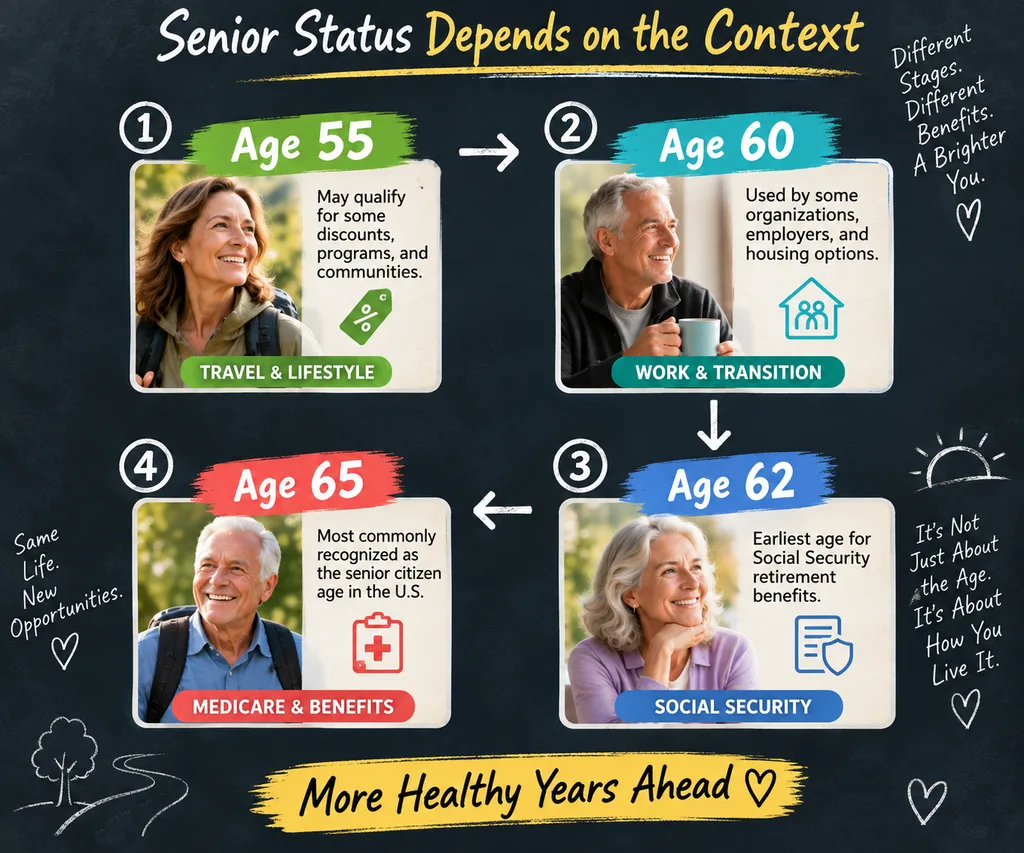
You’re simply matching your age to the rule that actually matters.
And if you’re looking for practical ideas for staying active, connected, and engaged during the senior years, you can continue here:
That may be the more useful question after all: not just when someone becomes a senior, but how to make those years meaningful, active, and enjoyable.
Looking Beyond Age
Age is only one part of healthy aging. As the years go by, questions about memory, focus, and mental clarity can become just as important.
That naturally raises another question: what are people exploring to support brain health as they age?
Lion’s Mane and other functional mushrooms are one area that has attracted attention, and Mindoxa is one example worth exploring.