


Age for Senior Citizens: What Age Counts in the U.S.?
When do you actually become a senior citizen in the United States?
Most people would probably answer 65. But ask about senior discounts, Social Security, Medicare, or local programs, and suddenly you may hear 55, 60, or 62 instead.
So which number is right?
The truth is more interesting: the age for senior citizens is not one universal number in the U.S. The age that matters depends on what you are trying to qualify for.
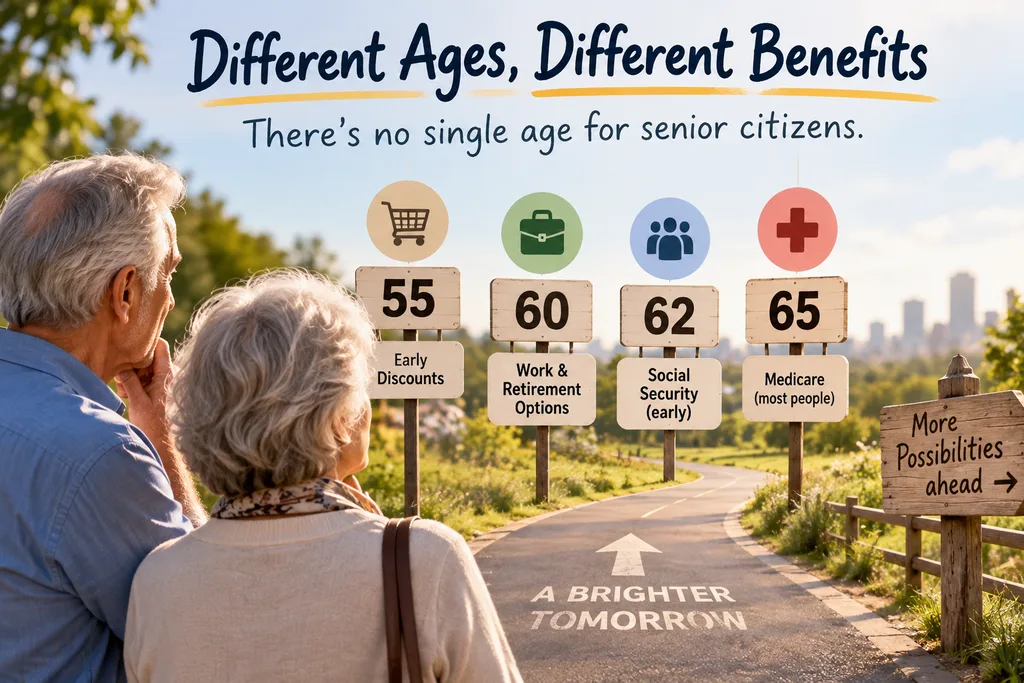
A business may offer a senior discount at 55. Another may use 60 or 65. Social Security retirement benefits can generally begin at 62, while Medicare eligibility is generally tied to age 65.
Understanding that difference can save you from a lot of confusion—and may help you discover benefits or discounts you did not realize you could qualify for.
What Age Is Considered a Senior Citizen in the USA?
There is no single age that automatically makes every American a senior citizen for every purpose.
If you are researching what age is a senior citizen in the USA, you will often see age 65 because it is one of the most widely recognized milestones for older adults.
But that does not mean every senior program begins at 65.
The age for senior citizens can depend on the organization, business, government program, or benefit involved.
For example, one company might define a senior customer as someone 55 or older. Another might require customers to be 60 or 65.
That means the better question is not simply, “Am I a senior?”
Instead, ask:
“What age do I need to be for the specific benefit I want?”
That small change makes the answer much easier to understand.
{→ when are you considered a senior citizen}
Is 55 Considered a Senior Citizen?
Sometimes, yes.
Some organizations and businesses use 55 as the starting point for senior discounts or programs. But reaching 55 does not automatically make you eligible for every senior benefit in the country.
Think of 55 as a possible eligibility age, not a universal definition.
This is one reason the age for senior citizens can look different from one website or business to another.
If you are 55, it is worth checking individual programs rather than assuming you are either “too young” or automatically qualified for everything.
Is 60 Considered a Senior Citizen?
So, is 60 considered a senior citizen?
The practical answer is: it depends.
Some organizations may recognize people at 60 as seniors. Others may use 55, 62, or 65.
This is especially important when you are looking for discounts. A senior discount is usually based on the individual company’s policy, so two businesses can have different age requirements.
The key insight is that “senior” does not always mean the same thing.
A person can be considered a senior for a local program at 60 without being eligible for a completely different benefit that starts at 65.
What Happens at Age 62?
Age 62 is an important milestone, but not because it creates one universal senior status.
It is important because you can generally begin receiving Social Security retirement benefits at 62. However, claiming benefits before your full retirement age can reduce your monthly benefit. For people born in 1960 or later, full retirement age is 67.
So when considering the age for senior citizens, keep this distinction in mind:
62 is a Social Security milestone, not a universal senior-citizen age.
That difference is easy to miss when you see several different numbers online.
Is 65 the Standard Senior Citizen Age?
If there is one number most Americans associate with senior adulthood, it is probably 65.
There is a good reason.
Most people become eligible to sign up for Medicare around age 65. Medicare says the Initial Enrollment Period generally begins three months before the month you turn 65 and ends three months after that month.
This makes 65 one of the most important milestones when discussing the age for senior citizens.
But there is an important catch.
Turning 65 does not automatically mean you qualify for every senior discount, state program, or private benefit.
Medicare, Social Security, and private senior discounts all have different rules.
Why Is 65 So Important?
The biggest reason is Medicare.
For most people, age 65 is when Medicare becomes an important part of healthcare planning. The connection between 65 and Medicare has also helped make 65 the age many Americans associate with becoming a senior.
But Social Security works differently.
For people reaching age 62 in 2026, the Social Security Administration says full retirement age is 67, while the Medicare eligibility age remains 65.
That is a perfect example of why there is no single age for senior citizens that answers every question.
What Age Qualifies for Senior Citizen Discounts?
The senior citizen discounts age varies from one business or organization to another.
You might find a discount beginning at 55, while another business may require you to be 60 or 65.
Imagine you are 60.
At one restaurant, you qualify for the senior discount.
At another, you do not.
That does not necessarily mean either business is wrong. They simply have different policies.
This is why it is better to ask the business directly:
“What age qualifies for your senior discount?”
That question gives you a more useful answer than relying on a general definition of senior age.
Senior Age vs. Medicare vs. Social Security
Here is the easiest way to see the difference:
| Age | What It May Mean |
|---|---|
| 55 | Some senior discounts or programs |
| 60 | Some organizations may recognize senior status |
| 62 | Social Security retirement benefits can generally begin |
| 65 | Major Medicare milestone and common senior benchmark |
| 66–67 | Full Social Security retirement age may apply depending on birth year |
The important thing is not to treat these ages as interchangeable.
A 62-year-old may be able to claim Social Security but still encounter a business whose senior discount begins at 65.
A 65-year-old may become eligible for Medicare but still need to meet separate requirements for a particular local program.
That is the real meaning behind the age for senior citizens.
Does Senior Citizen Age Vary by State?
It can, particularly when you are looking at state or local programs.
A senior center may have one age requirement. A state benefit may have another. A private business can establish its own discount policy.
This is why searching for a single “official” senior age can sometimes create more confusion than it solves.
If you are researching a legal or government-related benefit, always check the actual eligibility rules for that specific program.
{ → legal senior citizen age }
The important question is always:
Senior for what?
Once you ask that, the different ages begin to make sense.
Quick Guide to the Age for Senior Citizens
If you just want the short version, remember these milestones:
55: Some senior discounts and programs may begin.
60: Some organizations may recognize you as a senior.
62: Social Security retirement benefits can generally begin, although claiming early can reduce the monthly benefit.
65: Medicare eligibility generally begins around this age, and 65 is a widely recognized senior milestone.
66–67: Full Social Security retirement age depends on your birth year.
So, the age for senior citizens is better understood as a collection of important milestones rather than one magic birthday.
Frequently Asked Questions
What age is considered a senior citizen?
There is no universal age in the United States. Age 65 is one of the most commonly recognized senior milestones, but some programs and businesses use younger ages.
Is 55 considered a senior citizen?
It can be for certain discounts or programs. However, age 55 does not automatically qualify you for every senior benefit.
Is 60 considered a senior citizen?
Sometimes. It depends on the organization, business, or program.
Is 62 considered a senior citizen?
Age 62 is a major Social Security retirement milestone, but it is not a universal definition of senior citizenship.
Is 65 considered a senior citizen?
Yes, 65 is widely recognized as a senior-age milestone in the U.S. It is also generally associated with Medicare eligibility.
What age do senior discounts usually start?
There is no universal starting age. Depending on the business, discounts may begin at 55, 60, 62, 65, or another age.
The Bottom Line
If you came here expecting one simple number, the answer may be surprising.
There isn’t one universal age for senior citizens in America.
Instead, different ages matter for different reasons.
55 may unlock certain discounts.
60 may qualify you for some senior programs.
62 is an important Social Security milestone.
65 is a major Medicare milestone and one of the most commonly recognized senior ages.
Before, these numbers may have seemed contradictory. Now you can see that they are simply answering different questions.
That is the real solution: do not ask only when someone becomes a senior. Ask what benefit, discount, or program they are trying to access.
Once you know that, finding the right eligibility age becomes much easier—and you may discover opportunities you were overlooking.
If you are ready to make the most of your later years, learning about activities for seniors is a natural next step. Staying active, connected, and engaged can make the years ahead feel less like a number on a calendar and more like a new chapter worth enjoying.

Getting older can also be a good time to look beyond age and eligibility and think about the bigger picture of healthy aging. For many people, that means paying more attention to memory, focus, mental clarity, and maintaining mental energy over time.
If that is something you would like to explore further, Mindoxa offers more information on brain health, memory, focus, healthy aging, and functional mushrooms such as Lion’s Mane.