

At What Age Do You Become a Senior Citizen? 7 Key Facts
Have you ever wondered at what age do you become a senior citizen? Most people would probably answer, “65.” And in the United States, 65 is indeed the age most commonly associated with being a senior.
But there is a catch.
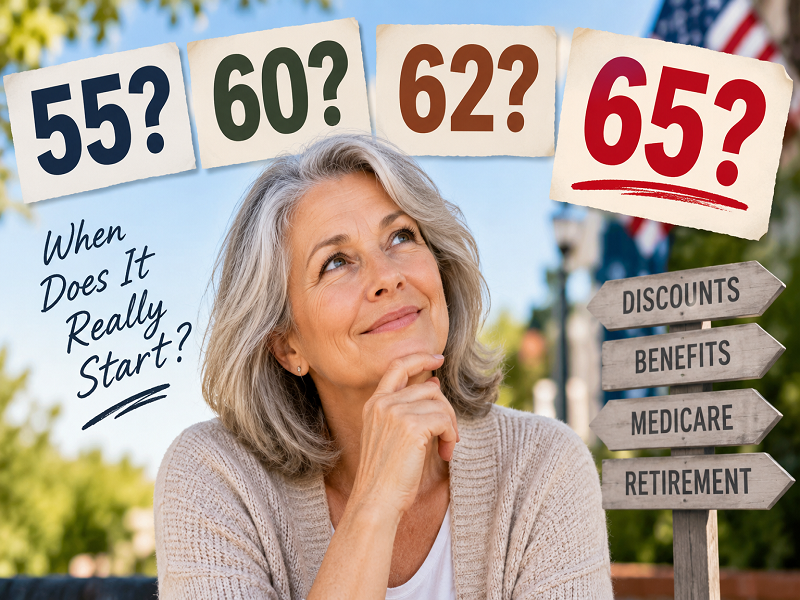
Why do you sometimes see 55, 60, or 62 mentioned when you search for the senior citizen age? And does turning 65 automatically mean you qualify for every senior discount, benefit, or government program?
Not quite. The answer is more interesting than a single birthday.
At What Age Do You Become a Senior Citizen?
For everyday purposes in the United States, 65 is the age most commonly considered the starting point of senior citizenship. That is why so many people use 65 when discussing senior citizens, retirement, and aging.
However, there is no single age that controls every program or benefit.
That distinction matters. A restaurant might offer a senior discount at 55 or 60, while another business may choose 65. Social Security has its own age rules, and Medicare generally begins around age 65 for people who qualify.
So, if you are asking at what age do you become a senior citizen, 65 is the simplest answer—but it is not the whole story.
{ → When are you considered a senior citizen }
At What Age Do You Officially Become a Senior Citizen?
This is where the question gets a little more complicated.
If you are wondering at what age do you officially become a senior citizen, there is not one universal federal birthday that automatically gives everyone the same senior status for every purpose.
Instead, different organizations and government programs use different age requirements.
Think of it this way: being a senior citizen is a broad social description, while eligibility for a specific benefit is determined by that program’s rules.
That is why someone who is 60 might receive a senior discount at one business but not another. Someone who is 62 may be eligible to claim Social Security retirement benefits, while Medicare generally uses 65 as its age-based eligibility milestone.
{ → At what age you are considered senior citizen}
Why Do 55, 60, 62, and 65 All Matter?
Here is the surprising part.
When people search when do you become a senior citizen at what age, they often expect one clear number. Instead, several ages appear because they can represent different milestones.
Age 55
Is 55 considered a senior citizen?
Understanding at what age do you become a senior citizen is easier when you look at what each of these age milestones actually means.
Not universally.
Some businesses, organizations, or programs may begin offering senior-related discounts at 55. That does not mean the entire country officially defines everyone aged 55 or older as a senior citizen.
Age 60
Is 60 considered a senior citizen?
Again, it depends.
Some programs and organizations use 60 as their eligibility threshold. Others use 55, 62, 65, or another age entirely.
This is why checking the specific program matters more than relying on a general definition.
Age 62
Age 62 is especially important because Social Security retirement benefits can generally begin at this age.
But there is an important distinction: 62 is a Social Security milestone, not a universal definition of senior citizenship.
Starting Social Security at 62 can also result in a permanently reduced monthly benefit compared with waiting until full retirement age.
Age 65
So, at what age do you become a senior citizen in the way most Americans commonly understand the term?
For most everyday conversations, 65 is the strongest answer.
It is also an important Medicare milestone. Medicare generally uses age 65 as the starting point for age-based eligibility, assuming you meet the other requirements.
{→ How old is considered senior citizen}
When Do Senior Citizen Discounts Start?
This is probably one of the most practical reasons people ask at what age do you become a senior citizen, especially when looking for senior discounts.
Unfortunately, there is no single senior discount age that every business follows.
One company may offer a discount beginning at 55. Another might choose 60. A third might require customers to be 65 or older.
That means you should not assume that turning 65 automatically unlocks every senior discount—or that being under 65 means you cannot receive one.
The simplest solution is to check the age requirement for the specific store, restaurant, attraction, transportation service, or membership program.
In other words, the question is not only “How old am I?” It is also “What age does this particular program use?”
Does Social Security or Medicare Determine Senior Citizen Age?
Not exactly.
If you are asking at what age do you become a senior citizen, Social Security and Medicare do not use exactly the same age rules.
Social Security retirement benefits can generally begin at 62. However, that does not mean everyone who turns 62 is officially classified as a senior citizen for every purpose. For people born in 1960 or later, the Social Security full retirement age is 67.
Medicare is different. Medicare says most people become eligible based on age at 65, although special circumstances can allow eligibility earlier.
This creates an important distinction:
Senior citizen age ≠ Social Security age ≠ Medicare rules.
Once you understand that difference, the confusing age numbers start to make much more sense.
What Changes When You Turn 65?
Before 65, you might simply think about getting older, continuing to work, saving for retirement, or deciding when to claim Social Security.
Around 65, more practical questions may appear.
You may need to think about Medicare enrollment, compare health coverage, look for senior discounts, review retirement income, and explore programs designed for older adults.
So the change is not necessarily a single switch that flips on your 65th birthday.
Instead, 65 can be the point where several important decisions begin to come together.
This is why knowing at what age do you become a senior citizen can be useful when planning for benefits, discounts, and retirement.

The Simple Answer: 65, But There Is More to It
If someone asks you at what age do you become a senior citizen, the short answer is 65 in the common U.S. usage.
But now you know why that answer needs a little context.
At 55, some senior programs may begin. At 60, some organizations may use a senior threshold. At 62, Social Security becomes an important retirement milestone. At 65, senior status becomes the most widely recognized benchmark, while Medicare becomes especially relevant.
That means you are not really looking for one magic number. You are looking for the age that applies to the benefit, discount, or program you care about.
Frequently Asked Questions
Is 55 years old considered a senior citizen?
Not universally. Some businesses and programs may use 55 as their senior age, but it is not a universal senior-citizen threshold.
Is 60 considered a senior citizen?
It can be in certain programs or organizations. However, there is no single rule requiring every business or government program to treat age 60 as senior age.
Is 65 considered a senior citizen?
Yes. Age 65 is the most commonly recognized senior-citizen benchmark in everyday U.S. usage, although specific programs can have different eligibility rules.
What age is considered a senior citizen in the USA?
For general purposes, 65 is the most common answer. However, the exact age can vary depending on whether you are discussing discounts, Social Security, Medicare, or another program.
At what age do you get a senior citizen discount?
There is no universal age. A business or organization may choose 55, 60, 62, 65, or another age for its own discount policy.
The Bottom Line
So, at what age do you become a senior citizen?
65 is the common answer—but it is not a universal rule for everything.
The real advantage comes from knowing the difference between a general senior age and the eligibility rules attached to specific benefits and programs.

Once you understand the 55, 60, 62, and 65 milestones, the whole subject becomes much easier to navigate. Instead of wondering whether you are “officially” a senior, you can focus on the more useful question:
Which benefits, discounts, and programs apply to me right now?
And that is where turning a certain age can become more than just a number—it can become the beginning of a new set of opportunities.
Turning 65 is often associated with retirement and benefits, but healthy aging involves more than those milestones. Memory, focus, mental clarity, and brain health can become just as important over time.
If you want to explore that side of healthy aging, Mindoxa is one place to learn more, particularly around Lion’s Mane and functional mushrooms.