


Memory Care Activities: 25 Ideas for Seniors
What if the best activity for someone with memory loss isn’t a puzzle at all?
Sometimes it is a song they have known for decades. Sometimes it is folding a towel, looking through family photographs, watering a plant, or simply sitting outside together.
That is what makes memory care activities different from ordinary games or entertainment. The goal is not to test someone’s memory or keep them busy for hours. The goal is to create a moment that feels familiar, manageable, and meaningful.
The challenge is finding activities that actually fit the person. Here are 25 simple activities for memory care that can be adapted to different abilities, interests, and moods.
What Makes Memory Care Activities Meaningful?
Good memory care activities for seniors usually have three things in common: they are familiar, simple, and connected to the person’s interests.
A former gardener may enjoy arranging flowers more than completing a worksheet. Someone who loved cooking may respond to sorting ingredients or looking through an old recipe book. A music lover may become engaged simply by hearing a favorite song.
This is an important shift in thinking. Memory care activities do not need to improve memory to be worthwhile. An activity can be valuable because it creates comfort, conversation, movement, or connection. The most effective memory care activities are often the ones that feel natural enough to become part of an ordinary day.
For more guidance on meaningful engagement, caregivers can also explore recommendations from the National Institute on Aging.
25 Memory Care Activities to Try
Reminiscence and Memory Activities
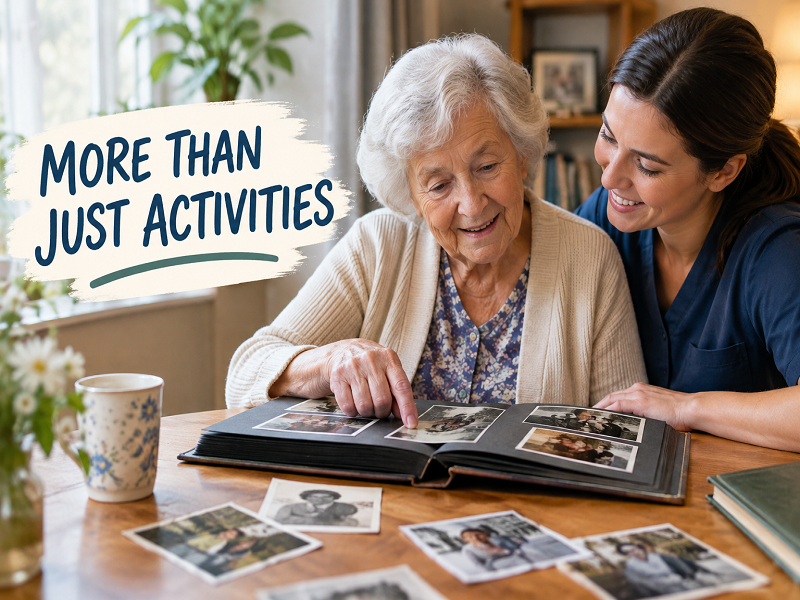
1. Look Through Family Photos
Choose several familiar photographs and talk about the people, places, and moments in them. There is no need to quiz the person about names or dates.
2. Make a Memory Box
Fill a small box with safe objects connected to family, work, hobbies, or everyday life.
3. Listen to Favorite Songs
Music can create an immediate feeling of familiarity. Play songs from earlier years and let the person sing, tap along, or simply listen.
4. Share Stories From the Past
Ask about childhood, holidays, favorite jobs, or family traditions. Let the conversation develop naturally.
5. Match Familiar Pictures
Use simple pairs of photographs or picture cards for a relaxed matching activity.
Creative Memory Care Activities
Creative projects can be especially helpful when someone enjoys using their hands.
6. Coloring
Choose large, simple designs and let the person decide which colors to use.
7. Simple Painting
Flowers, landscapes, houses, and familiar objects are easy subjects to explore without pressure.
8. Create a Collage
Use old magazines, calendars, or safe photographs to create a simple picture together.
9. Make Seasonal Decorations
Simple crafts for spring, autumn, birthdays, or holidays can provide a familiar reason to create something.
10. Decorate a Familiar Object
Try a picture frame, flowerpot, greeting card, or another everyday item.
These memory care activities ideas can easily be simplified. If a project has too many steps, remove some. If too many materials cause confusion, put only two or three choices on the table.
Cognitive Activities for Memory Care
11. Card Matching
Begin with just a few pairs. Add more only if the person is comfortable and interested.
12. Sort Familiar Objects
Sorting safe household objects by color, size, or type can provide a simple task with a clear beginning and end.
13. Try a Simple Puzzle
Choose a familiar image and a manageable number of pieces rather than focusing on difficulty.
14. Play Category Games
Choose a category such as animals, foods, flowers, or places and invite the person to name whatever comes to mind.
15. Match Colors and Shapes
Simple visual matching can be a good alternative when traditional puzzles become frustrating.
The purpose of these activities for memory care patients is participation. There is no need to correct every answer or turn the activity into a test.
Sensory, Physical, and Social Activities
16. Explore a Sensory Box
Use safe objects with different textures, shapes, and familiar characteristics.
17. Water Plants
Gardening can combine movement, purpose, and a familiar hobby. Even a small indoor plant can work.
18. Explore Familiar Scents
Safe aromas associated with flowers, cooking, or favorite foods may encourage conversation and reminiscence.
19. Fold Towels or Napkins
A simple household task can feel meaningful because there is an obvious purpose.
20. Arrange Flowers
Give the person a few flowers and allow them to decide how to arrange them.
21. Do Gentle Chair Exercises
Simple seated movements can add physical activity without requiring complicated instructions.
22. Try Gentle Stretching
Keep movements comfortable and provide assistance when needed.
23. Dance to Familiar Music
Put on a favorite song and encourage whatever movement feels comfortable.
24. Play a Simple Group Game
Music games, matching games, sing-alongs, and easy crafts can work well as group activities for memory care patients.
25. Spend Time Outdoors
Sitting in a garden, watching birds, watering plants, or taking an appropriate walk can provide a refreshing change of environment.
{ → Sensory activities for dementia patients }
How to Choose the Right Activities
One of the biggest mistakes with activities for memory care seniors is assuming that a more challenging activity is automatically better.
It isn’t.
Start with the person’s abilities, interests, energy level, attention span, and need for assistance. These factors can change from one day to another.
If an activity is too difficult, simplify it. If it feels childish, replace it with something connected to the person’s adult life. If the person seems tired, choose something quiet.
The best memory care activity ideas are flexible enough to change with the person. Good memory care activities should fit the person, not force the person to fit the activity.
Fun Activities for Memory Care Residents
Fun does not have to mean loud games or complicated entertainment.
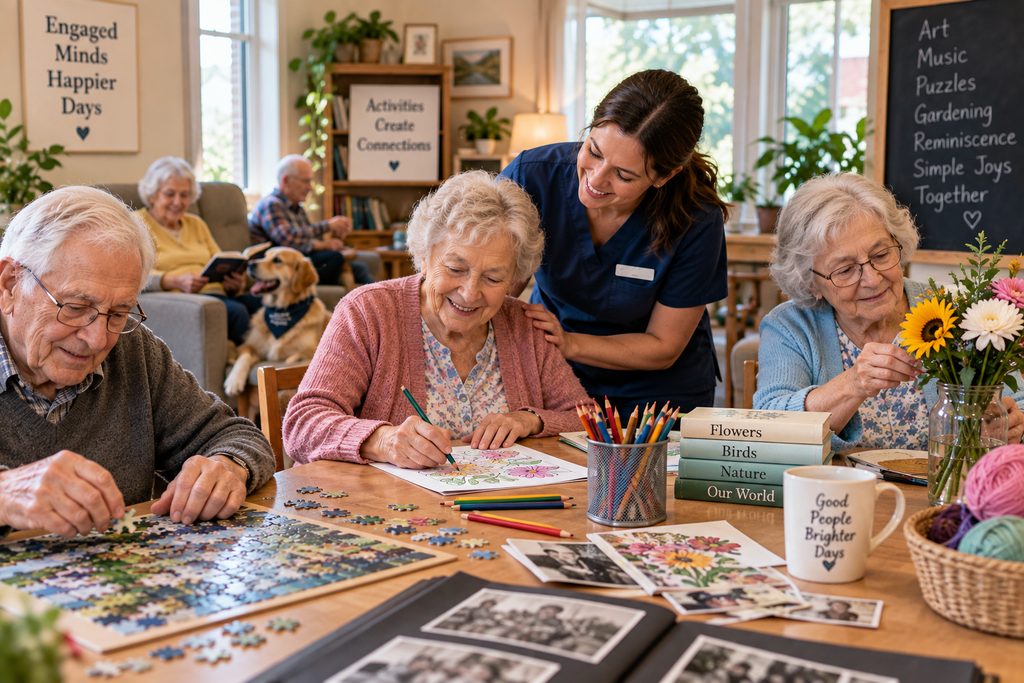
Some of the best fun activities for memory care residents are ordinary things done together: listening to music, arranging flowers, looking through photographs, baking something simple, or spending time outdoors.
For families searching for activities to do with memory care residents, a useful rule is simple: start with something the person already knows.
That familiar starting point often makes participation much easier.
{ → Useful distraction techniques for dementia caregivers }
Memory Care Activities Calendar: A Simple 7-Day Plan
A predictable routine can make choosing memory care activities much easier.
| Day | Activity | Focus |
|---|---|---|
| Monday | Family photographs | Reminiscence |
| Tuesday | Favorite music | Sensory |
| Wednesday | Water plants | Purpose |
| Thursday | Coloring | Creativity |
| Friday | Sorting objects | Cognitive |
| Saturday | Gentle dancing | Movement |
| Sunday | Storytelling | Connection |
This memory care activities calendar is only a starting point. A memory care activity calendar should leave room for the person’s mood and abilities. The goal is to make memory care activities easy to plan while keeping the daily routine flexible and personal.
In a care setting, a memory care unit activity calendar can rotate between music, crafts, movement, reminiscence, and social activities rather than repeating the same type of activity every day.
Families may also find that memory care activity calendars work better when they include both planned activities and flexible quiet-time options.
The important thing is having ideas ready without making the schedule feel rigid.
What If an Activity Does Not Work?
It will happen.
You may prepare everything perfectly and the person simply does not want to participate. That does not mean you chose badly.
If the activity creates frustration, stop and simplify it. If the person loses interest, try something different. If they are tired, give them time to rest.
Sometimes memory care activities work best when they are offered rather than imposed.
The same principle applies to activities for memory care residents in group settings. Not everyone needs to participate in the same way. One person may paint, another may watch, and someone else may simply listen to the music.
All three can be meaningful forms of participation.
A Small Change Can Create a Big Difference
Imagine an afternoon where a complicated puzzle sits untouched on the table.
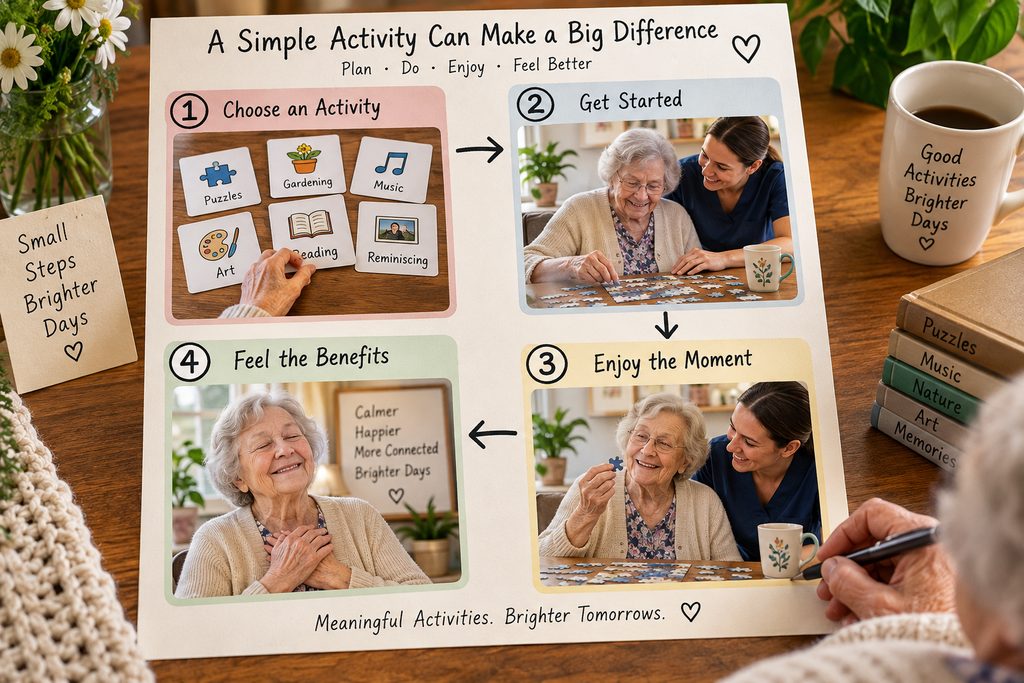
Now imagine replacing it with a familiar song and a small album of family photographs. The person begins humming. Then they point to a photograph. A story follows.
Nothing about the second activity is complicated.
But the atmosphere has changed.
That is the real value of memory care activities. You are not forcing someone to remember. You are creating an opportunity for recognition, comfort, expression, and connection.
And once you discover which activities bring out those responses, planning becomes much easier.
{ → Memory aids for dementia }
Frequently Asked Questions
What are some creative activities for memory care?
Coloring, painting, collages, flower arranging, seasonal crafts, and decorating familiar objects are simple options. Adjust the number of steps to the person’s ability.
What are good memory activities?
Family photographs, familiar music, storytelling, memory boxes, matching games, sorting, and familiar hobbies can all encourage meaningful engagement.
What are calming activities for dementia patients?
Familiar music, photographs, folding towels, sensory activities, simple crafts, and quiet outdoor time can be good choices when someone feels tired or overwhelmed.
How do you keep someone engaged?
Start with something familiar, keep instructions short, offer limited choices, and pay attention to the person’s response. If they stop enjoying an activity, change direction.
Final Thoughts
The best memory care activities are not necessarily the most expensive, complicated, or impressive.
Sometimes they are wonderfully ordinary.
A favorite song. A family photograph. A few flowers. A towel to fold. A story worth telling again.
Start with one simple activity today. Watch what creates interest, comfort, or a smile. Then build tomorrow’s routine around what you learn.
Because when the right activity meets the right person at the right moment, something important can happen: a routine becomes a meaningful moment of connection.
Daily activities are only one part of supporting memory and brain health. If you’re also curious about other ways to support memory function as part of a broader healthy-aging routine, there are natural options worth exploring.
NeuroVera is one of them, with ingredients including Lion’s Mane, Bacopa, Gotu Kola, Schisandra, and Shilajit. It is designed around supporting memory function and overall brain health, particularly for adults looking at long-term cognitive wellness.
Curious about what’s inside and how it fits into a broader approach to brain health?