

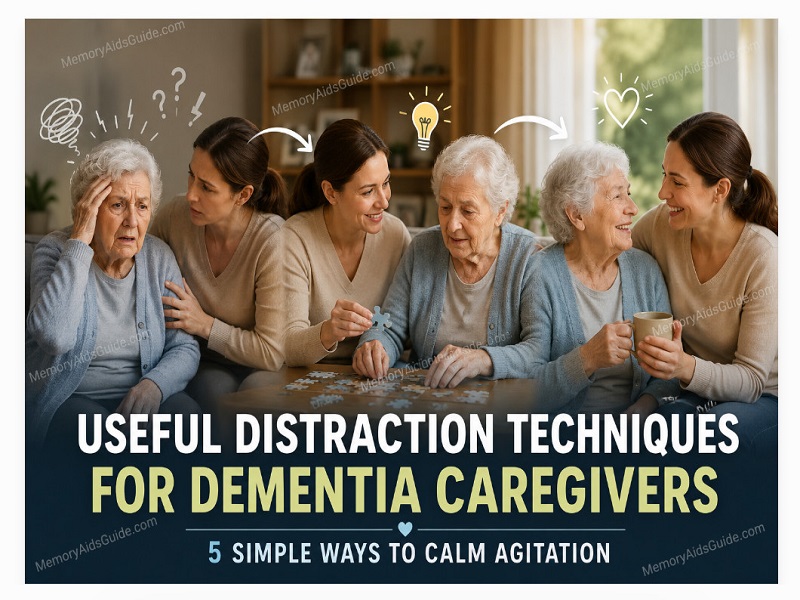
Useful Distraction Techniques for Dementia Caregivers
When a person with dementia becomes upset, restless, or fixated on something worrying, your first instinct may be to explain the situation or correct them. Unfortunately, that can sometimes make the moment more difficult.
A gentler change of focus may work better.
Useful distraction techniques for dementia caregivers can help shift attention toward something familiar, calming, or enjoyable. That might be a favorite song, a snack, a short walk, family photographs, or a simple activity.
The goal isn’t to ignore what the person is feeling. It’s to help them move through a difficult moment without adding more frustration.
For many families, learning a few useful distraction techniques for dementia caregivers can make these difficult everyday moments feel more manageable.
What Are Distraction Techniques for People With Dementia?
Distraction is a form of gentle redirection. Instead of keeping the person’s attention on something that is causing distress, you offer another activity, conversation, object, or environment.
For example, imagine that someone keeps saying:
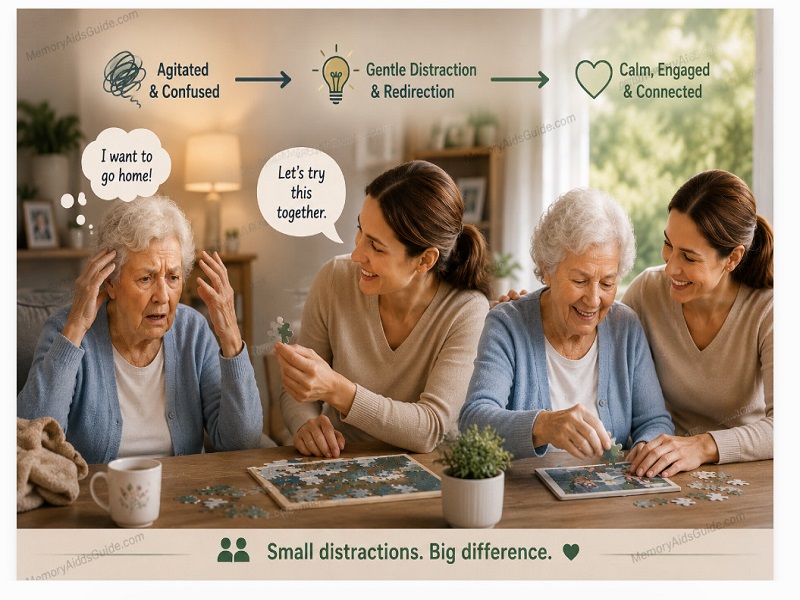
“I want to go home.”
Telling them repeatedly, “You are already home,” may lead to an argument. Instead, acknowledge the feeling first:
“You want to go home. You seem worried.”
Then offer another focus:
“Let’s sit down and have some tea.”
The point isn’t to prove that the person is wrong. It’s to give them somewhere else to place their attention.
This gentle approach is one of the central ideas behind useful distraction techniques for dementia caregivers, because the goal is to redirect attention without dismissing the person’s feelings.
5 Useful Distraction Techniques for Dementia Caregivers
1. Start a New Activity
When someone becomes stuck on a thought or behavior, try offering a simple activity they already know.
Depending on their interests and abilities, you could suggest:
- Folding towels
- Looking through family photographs
- Listening to a favorite song
- Watering plants
- Sorting familiar objects
- Reading a short book
- Watching a favorite program
Keep the task easy enough that the person can feel successful. If an activity becomes frustrating, simplify it or stop.
Activities should be matched to the person’s abilities and interests rather than chosen simply because they seem entertaining to the caregiver.
Starting something familiar is often one of the simplest useful distraction techniques for dementia caregivers, especially when the person is becoming stuck on a particular thought or behavior.
2. Offer Something Familiar
A favorite activity, snack, drink, or short walk can make redirection feel natural.
You might say:
“Would you like to listen to your favorite song?”
or:
“Let’s take a little walk together.”
Try offering one simple choice at a time. Too many choices can be confusing when someone is already distressed.
Familiar things can be especially useful because the person doesn’t have to learn how to do something new while they are already having a difficult moment.
For this reason, useful distraction techniques for dementia caregivers often work best when they involve something the person already knows and enjoys.
3. Bring Up a Fond Memory
A familiar memory can give the conversation a completely different direction.
You might look at:
- Old family photographs
- A favorite song
- Pictures of a former hobby
- A beloved pet
- A familiar place
- A favorite meal
You don’t need to ask, “Do you remember this?” or test whether the person remembers every detail.
Instead, simply start talking about it.
“This was your garden, wasn’t it? You always loved those flowers.”
The conversation itself can become the distraction.
Using meaningful memories is another example of useful distraction techniques for dementia caregivers, particularly when a familiar topic can gently move the conversation in a calmer direction.
NIA guidance also recommends familiar activities, photos, music, and other meaningful experiences when adapting activities for someone with Alzheimer’s disease.
4. Remove Unnecessary Stimulation
Sometimes the person doesn’t need more to focus on. They need less.
A loud television, several people talking, clutter, bright activity, or constant background noise can make communication harder.
Before introducing another distraction, look around.
Could you:
- Turn down the television?
- Move somewhere quieter?
- Ask other people to give the person some space?
- Remove unnecessary clutter?
- Turn off distracting sounds?
Reducing noise and clutter is part of creating a more comforting environment for someone experiencing agitation.
Useful distraction techniques for dementia caregivers do not always mean adding a new activity. Sometimes reducing unnecessary stimulation is the most helpful form of redirection.
In these moments, the best distraction may simply be a quieter room.
5. Redirect Instead of Arguing
This can be especially useful when someone is becoming agitated.
Suppose the person insists that they need to leave. Saying “No, you can’t” over and over may turn the situation into a confrontation.
Try:
“You’d like to go somewhere. Let’s sit down for a minute.”
Then offer something familiar.
The same approach can work when the person repeats a question, becomes frustrated during a task, or starts worrying about something you cannot easily change.
Stay calm, listen to the concern, and give the person time to respond. NIA recommends avoiding arguments, using a calm manner, listening to concerns, and redirecting attention to another object or activity.
Redirecting rather than arguing is one of the most important useful distraction techniques for dementia caregivers because confrontation can sometimes increase distress instead of resolving it.
How to Calm an Agitated Person With Dementia
Distraction isn’t always the first thing to try. First, consider why the person may be agitated.
They could be tired, hungry, uncomfortable, in pain, overwhelmed by noise, confused by a change in routine, or having trouble sleeping. Agitation and aggression often have a reason, so looking for the trigger can be more useful than simply trying to stop the behavior.
If the person is mildly upset, slow things down. Use a calm voice, reduce stimulation, listen, and offer one familiar activity.
When considering useful distraction techniques for dementia caregivers, it is important to remember that understanding the possible cause of agitation may help you choose a more appropriate response.
What If They Want to Go Home?
This situation can be particularly hard for caregivers.
Instead of repeatedly explaining why they cannot leave, try responding to the emotion behind “I want to go home.” The person may be looking for safety, familiarity, reassurance, or someone they associate with home.
Acknowledge the feeling and then redirect:
“You miss home. Let’s look at these photographs together.”
You don’t need to find the perfect response. You simply want to avoid turning the moment into an argument.
In situations like this, useful distraction techniques for dementia caregivers may include shifting attention toward something familiar while still acknowledging the emotion behind the person’s words.
What About Dementia at Night?
Some people experience more restlessness, confusion, or agitation later in the day or at night. This is sometimes called sundowning.
A predictable evening routine and a quieter environment may help. Consider a familiar book, soothing music, a quiet conversation, or another low-key activity.
Don’t overload the evening with activities. Sometimes less stimulation is more helpful.
Gentler useful distraction techniques for dementia caregivers may be particularly appropriate at night, when too much activity or stimulation could make restlessness worse.
And caregivers need breaks too. If you’re becoming overwhelmed, stepping away briefly when it is safe to do so can help you return with a calmer response.
What Should Dementia Caregivers Avoid?
Distraction should feel like an invitation, not a demand.
Try to avoid:
- Arguing about facts
- Raising your voice
- Repeatedly correcting the person
- Giving too many choices
- Forcing an activity
- Continuing when the person becomes more distressed
- Treating difficult behavior as deliberate misbehavior
Communication matters. Use simple language, allow extra time for responses, and avoid interrupting or arguing.
If one technique doesn’t work, don’t keep pushing it. Change the activity, reduce stimulation, or give the person some quiet time.
Even the best useful distraction techniques for dementia caregivers should be stopped if the person becomes increasingly distressed or clearly does not want to participate.
What If the Person Becomes Aggressive?
Safety comes first.
If someone becomes physically aggressive or appears likely to hurt themselves or another person, distraction should not be treated as the solution to everything. Give the person space, reduce stimulation, avoid confrontation, and get appropriate help when necessary.
Useful distraction techniques for dementia caregivers can be helpful in some difficult moments, but they should never replace appropriate professional help when someone becomes unsafe.
For people living with Lewy body dementia, changes in attention, perception, or hallucinations can sometimes contribute to distress. In those situations, arguing about what the person sees or hears may increase tension. A calm response to the emotion and gentle redirection, when appropriate, may be more useful.
Frequently Asked Questions
What are some distraction techniques for people with dementia?
Try a familiar activity, favorite music, photographs, a suitable snack or drink, a short walk, reading, or a simple household task. Choose something that fits the person’s interests and abilities.
These useful distraction techniques for dementia caregivers are generally most effective when they match the person’s abilities, interests, and current emotional state.
What are some effective ways to communicate with people with dementia?
Speak calmly, use simple language, allow extra time for responses, listen to their concerns, and avoid arguing or repeatedly correcting them. If they don’t understand, try saying the idea in different words.
What are common dementia caregiver mistakes?
Common mistakes include arguing, rushing the person, giving too many instructions, forcing an activity, raising your voice, and overlooking possible causes of agitation such as pain, tiredness, poor sleep, or environmental stress.
The Bottom Line
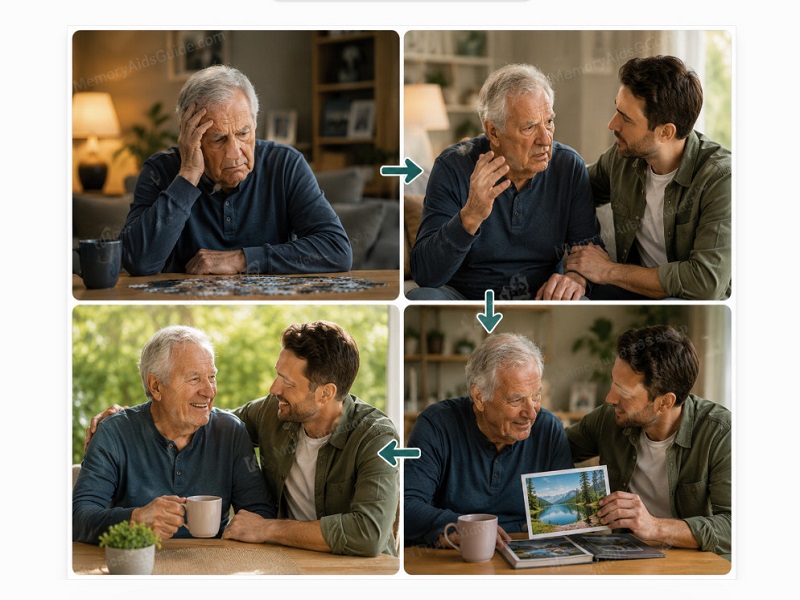
The best distraction isn’t necessarily the most interesting activity. It’s the one that helps the person feel calmer, safer, and less overwhelmed.
Useful distraction techniques for dementia caregivers can include a favorite song, family photographs, a familiar snack, a short walk, a quiet room, or a simple activity that gives the person something else to focus on.
Start with something familiar. Listen before redirecting. Keep your choices simple. Reduce unnecessary stimulation when needed.
For many families, useful distraction techniques for dementia caregivers work best when they are flexible rather than forced. What works one day may not work the next, so paying attention to the person’s reactions remains important.
And remember: distraction is one tool, not a solution for every difficult behavior. If agitation is sudden, severe, or unsafe, look for the underlying cause and get appropriate professional help.
Sometimes a favorite song, a family photograph, a cup of tea, or a few quiet minutes together is enough to help a difficult moment pass.
A Few Quiet Minutes for Yourself
Caring for someone with dementia can be emotionally demanding. After spending so much time helping someone else, caregivers sometimes need a few quiet minutes to reset and refocus, too.
Could a simple 12-minute daily audio routine help create a calmer, clearer moment in your day?
That question led us to The Memory Wave, an audio program marketed to support mental clarity, focus, and calm thinking.
Curious about how it works? Find out more about The Memory Wave.