


Dementia Difference Between Alzheimer’s: What’s the Difference?
Dementia and Alzheimer’s are often used as if they mean the same thing. They don’t.
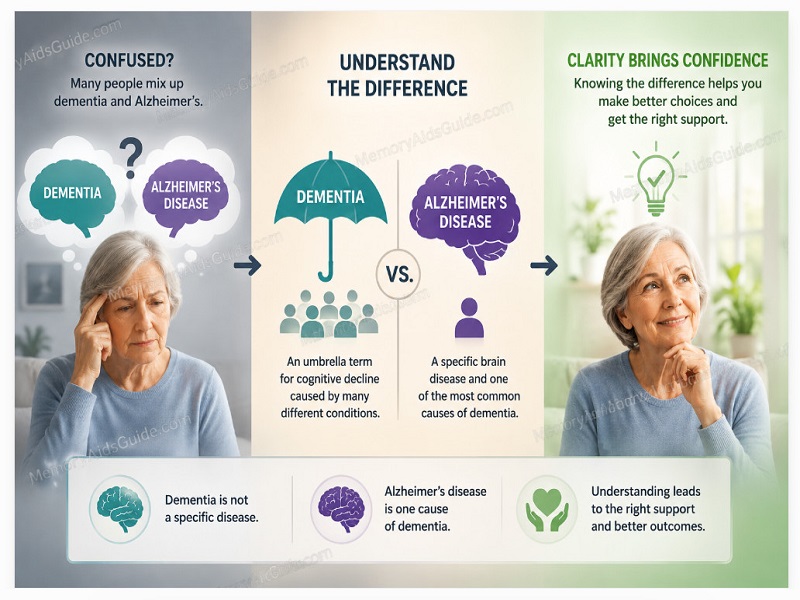
The easiest way to understand the dementia difference between Alzheimer’s is to separate the two concepts: dementia is a general term for significant cognitive decline that interferes with daily life, while Alzheimer’s disease is a specific brain disease that can cause dementia.
That distinction matters because a person can have dementia without having Alzheimer’s.
Alzheimer’s is the most common dementia diagnosis in older adults, but other diseases can cause dementia too.
Understanding this dementia difference between Alzheimer’s can help prevent one of the most common misunderstandings about memory loss and cognitive decline.
Dementia vs. Alzheimer’s: The Key Difference
Think of dementia as an umbrella term.
Under that umbrella are several diseases and conditions that can cause cognitive decline. Alzheimer’s disease is one of them. Vascular dementia, Lewy body dementia, and frontotemporal dementia are other examples.
The simplest way to understand the dementia difference between Alzheimer’s is this:
Dementia describes the problem. Alzheimer’s is one disease that can cause that problem.
This is also why the two terms should not be treated as interchangeable.
They are closely connected, and they share many similarities, but they do not mean exactly the same thing.
Once this relationship becomes clear, the dementia difference between Alzheimer’s becomes much easier to understand.
What Is Dementia?
Dementia means that a person’s cognitive functioning has declined enough to interfere with everyday life.
It can affect thinking, remembering, reasoning, communication, judgment, behavior, and the ability to manage familiar activities.
It is also not a normal part of aging.
Occasional forgetfulness can happen as people get older, but dementia involves more significant changes in cognitive functioning and daily activities.
Importantly, dementia is not a single disease.
Different underlying conditions can produce different patterns of symptoms. This is an important part of understanding the dementia difference between Alzheimer’s because the word dementia alone does not tell you exactly what is happening in the brain.
For example, vascular dementia is associated with conditions that damage blood vessels or disrupt blood flow in the brain.
Lewy body dementia can involve changes in thinking, movement, behavior, mood, and other functions.
Frontotemporal dementia can particularly affect behavior or language.
So, when someone is diagnosed with dementia, another question still remains: What is causing it?
And memory loss by itself does not automatically mean dementia.
If you’re trying to understand that distinction more closely, our guide to amnesia vs dementia can help.
What Is Alzheimer’s Disease?
Alzheimer’s disease is a specific progressive brain disease and the most common dementia diagnosis among older adults.
This is one of the most important facts behind the dementia difference between Alzheimer’s.
It gradually affects memory and thinking abilities and, as the disease progresses, can interfere with a person’s ability to carry out everyday activities.
Memory problems are often among the early noticeable symptoms, although Alzheimer’s can eventually affect language, reasoning, judgment, behavior, and other cognitive abilities.
Alzheimer’s is associated with characteristic changes in the brain, including abnormal accumulations of amyloid plaques and tau tangles.
These biological changes can occur before noticeable symptoms of dementia appear.
That helps explain why “Which comes first, Alzheimer’s or dementia?” can be a confusing question.
The disease process associated with Alzheimer’s can begin before a person develops the level of cognitive and functional impairment described as dementia.
So, the dementia difference between Alzheimer’s is not about two completely unrelated conditions.
Instead, one is a broad term describing cognitive decline, while the other is a specific disease that can lead to that decline.
Can You Have Dementia Without Alzheimer’s?
Yes.
A person can have dementia caused by something other than Alzheimer’s disease.
Understanding this point is essential to understanding the dementia difference between Alzheimer’s.
Some of the other major types include:
- Vascular dementia
- Lewy body dementia
- Frontotemporal dementia
- Mixed dementia
Symptoms can overlap between these conditions, which can make diagnosis difficult.
Some people may also have more than one type of brain pathology contributing to their cognitive decline.
For example, someone with vascular dementia may have problems with memory, thinking, or judgment related to damage affecting blood flow in the brain.
Someone with Lewy body dementia may have cognitive changes alongside movement or visual symptoms.
Knowing the dementia difference between Alzheimer’s helps explain why confusion, memory problems, or changes in thinking should not automatically be assumed to result from Alzheimer’s disease.
The underlying cause matters.
Can You Have Dementia and Alzheimer’s?
Yes — because the two terms describe different things.
A person can have Alzheimer’s disease and develop dementia as the disease affects memory, thinking, and everyday functioning.
At the same time, another person can have dementia without Alzheimer’s because a different disease is responsible.
There is also mixed dementia, where more than one disease or brain pathology contributes to the person’s cognitive decline.
This relationship is at the heart of the dementia difference between Alzheimer’s.
So the key relationship is simple:
Alzheimer’s can cause dementia, but dementia does not automatically mean Alzheimer’s.
That is why saying that someone “has dementia” does not necessarily tell you which specific disease is causing the cognitive changes.
A proper diagnosis may require looking beyond the symptoms themselves.
How Do You Tell If It’s Alzheimer’s or Dementia?
You generally cannot determine the underlying cause from one symptom alone.
Memory loss, confusion, difficulty finding words, poor judgment, and problems completing familiar activities can occur with different types of dementia.
The overall pattern matters more than any single symptom.
This makes the dementia difference between Alzheimer’s more complicated than simply looking at one symptom and trying to decide what it means.
A healthcare professional may consider:
- When the symptoms began
- How they have changed over time
- Medical and family history
- Memory and thinking abilities
- Physical and neurological findings
- Laboratory tests
- Brain imaging or other tests when appropriate
The goal is not simply to answer, “Does this person have dementia?”
It is also to determine what may be causing the cognitive changes.
For example, Alzheimer’s often has prominent memory problems early in the disease, while other dementias may show more noticeable changes in behavior, language, movement, attention, or visual processing.
But there can be significant overlap, so symptoms alone are not enough to make a diagnosis.
Understanding the dementia difference between Alzheimer’s means recognizing that similar symptoms do not always have the same underlying cause.
If memory or thinking changes are beginning to interfere with everyday life, discussing them with a healthcare professional is a better next step than trying to identify the cause from a symptom checklist.
Which Is Worse: Dementia or Alzheimer’s?
This question comes up often, but it is actually comparing two different things.
Dementia describes a condition of cognitive decline. Alzheimer’s describes one disease that can cause that condition.
This is another reason the dementia difference between Alzheimer’s matters when discussing symptoms and disease progression.
So it would be misleading to say that dementia is always worse than Alzheimer’s, or that Alzheimer’s is always worse than dementia.
A more useful question is:
What is causing the dementia, how advanced is it, and how much is it affecting the person’s daily life?
Dementia can range from relatively mild impairment to severe cognitive and functional problems.
Alzheimer’s disease itself is progressive, and symptoms can become more severe as the disease advances.
The impact on an individual person depends on the underlying disease, the stage of cognitive decline, and many other factors.
So before comparing which condition is “worse,” it is important to understand the dementia difference between Alzheimer’s and what each term actually describes.
What Should You Do If You Notice Cognitive Changes?
If memory, thinking, judgment, or everyday functioning has noticeably changed, it is worth talking with a healthcare professional.
That does not mean every memory problem is Alzheimer’s or dementia.
A proper evaluation can help identify the underlying cause and determine what kind of support may be appropriate.
The CDC also advises seeking medical evaluation when concerning changes in memory or thinking occur.
Understanding the dementia difference between Alzheimer’s may help a person ask better questions, but it cannot replace a professional evaluation.
For people already dealing with cognitive changes, practical tools can also make everyday routines easier.
Depending on the person’s needs, memory aids for dementia may provide useful support with reminders, routines, and everyday tasks.
You may also want to explore memory aids for mild cognitive impairment if the changes are still relatively mild.
The right type of support may depend on the person’s symptoms, abilities, and the cause of the cognitive changes.
The Bottom Line
The dementia difference between Alzheimer’s becomes much easier to understand once you separate the general condition from the specific disease.
Dementia is a general term for significant cognitive decline that interferes with daily life.
Alzheimer’s disease is a specific progressive brain disease and the most common dementia diagnosis among older adults.
A person can have dementia without Alzheimer’s.
A person with Alzheimer’s can develop dementia as the disease progresses.
And because several different diseases can cause similar symptoms, the underlying cause should be evaluated rather than assumed.
The most important thing to remember about the dementia difference between Alzheimer’s is simple:
Dementia is the broad term. Alzheimer’s is one specific disease that can cause dementia.
Understanding that relationship can make the terminology less confusing and help people take a more informed next step when cognitive changes become a concern.

Frequently Asked Questions
How do you tell if it’s Alzheimer’s or dementia?
Dementia describes the cognitive decline, while Alzheimer’s is one specific disease that can cause it.
Doctors consider the person’s symptoms, medical history, cognitive changes, and other appropriate tests to help determine the underlying cause.
This evaluation is important because understanding the dementia difference between Alzheimer’s requires identifying more than just the presence of memory problems.
Can someone have dementia but not Alzheimer’s?
Yes.
Dementia can result from conditions such as vascular dementia, Lewy body dementia, frontotemporal dementia, and other causes.
This is why dementia does not automatically mean that a person has Alzheimer’s disease.
How do you treat someone with dementia?
Support and treatment depend on the underlying cause and the person’s individual needs.
Some treatments may help manage symptoms or contributing conditions, while there is currently no cure for the major neurodegenerative dementias.
A healthcare professional can help determine an appropriate care plan.
Still Wondering About Everyday Memory Changes?
Not every moment of forgetfulness means dementia or Alzheimer’s. But if you’ve ever wondered why memory, mental clarity, or finding the right words can sometimes feel more difficult, there may be more to understand.
Want to learn more? Explore a different perspective on everyday memory support →
See More
Amnesia vs Dementia
Understand how amnesia differs from dementia and why memory loss alone does not necessarily mean dementia.
Memory Aids for Dementia
Explore practical tools that may help with memory, reminders, and everyday routines.
Dementia Memory Aids
Learn about different memory-support options for people living with dementia.
Memory Aids for Mild Cognitive Impairment
Explore external memory aids that may help support everyday tasks when memory changes are mild.