

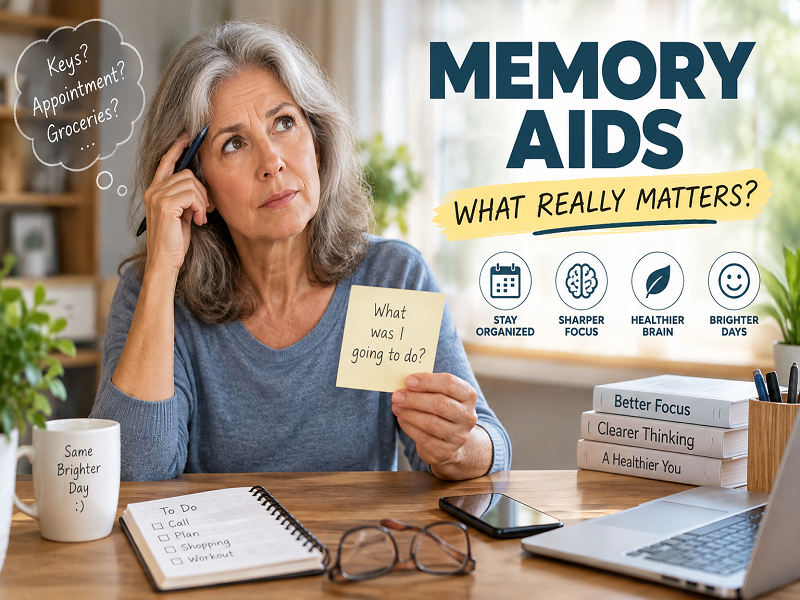
16 Memory Aids to Explore for Memory, Focus & Brain Health
Have you ever walked into a room and completely forgotten why you were there?
Or had a familiar name sitting just out of reach, even though you know you know it?
These little moments are easy to brush off. But when they start happening more often, many people naturally begin looking for ways to stay organized, focused, and mentally sharp.
That’s where memory aids come in.
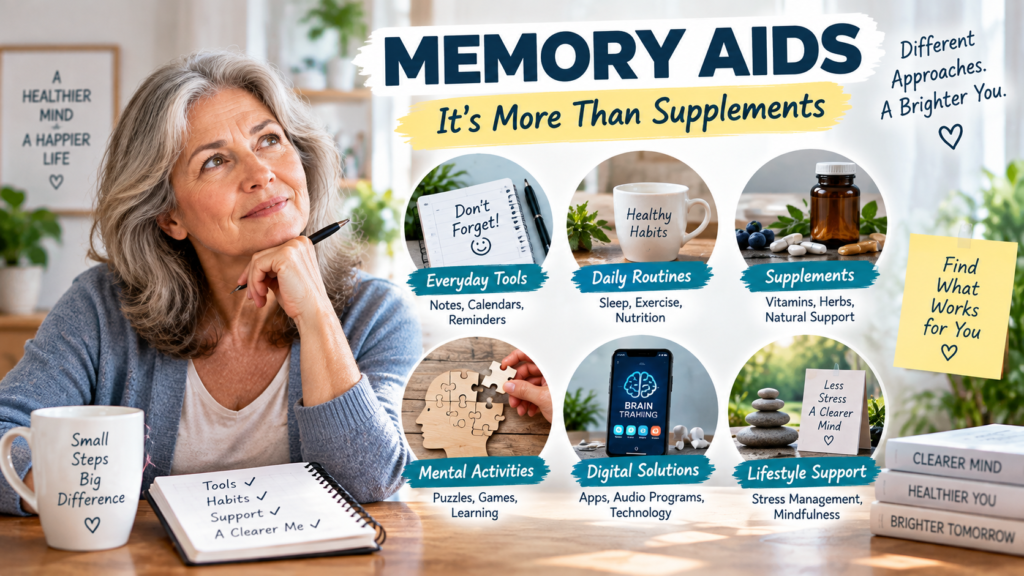
The surprising part is that they are not limited to supplements. They can include simple everyday tools, mental activities, technology, nutritional formulas, and digital programs built around focus or mental clarity.
The difficult part isn’t finding options. There are plenty of them.
The difficult part is figuring out what is actually different between them — and which approaches are even worth exploring.
That’s what this guide is here to simplify.
What Are Memory Aids?
At their simplest, memory aids are tools or strategies that help you remember information, organize daily life, stay focused, or manage everyday forgetfulness.
That could mean something as ordinary as a calendar, notebook, reminder app, or keeping your keys in the same place every day.
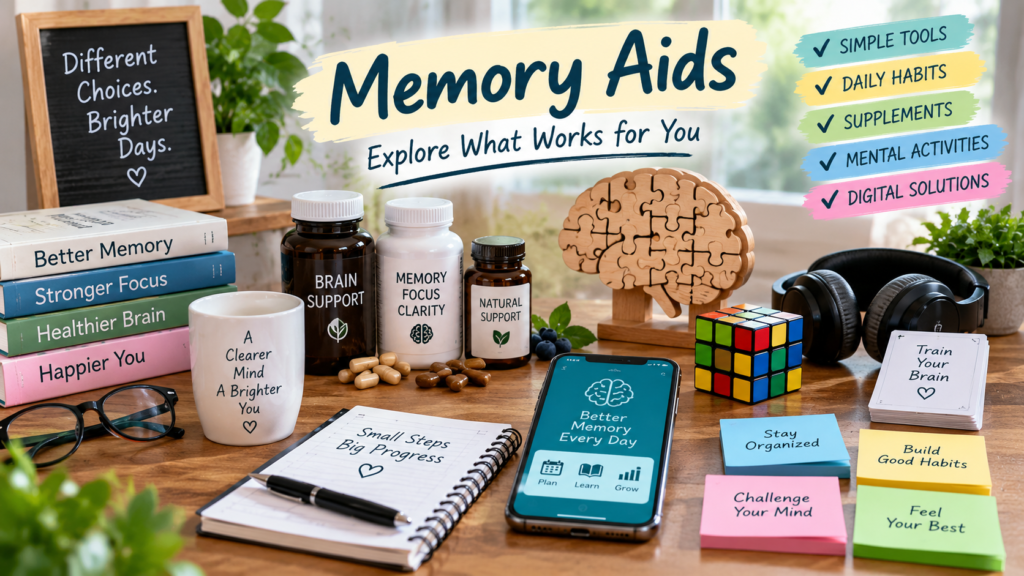
It can also mean cognitive activities, lifestyle habits, supplements, or digital programs marketed around memory and brain health.
The National Institute on Aging recommends practical strategies such as following routines, making lists, using calendars and notes, learning new skills, staying active, getting enough sleep, and remaining socially connected.
So memory aids don’t have to mean taking something.
Sometimes the simplest solution is also the most useful one.
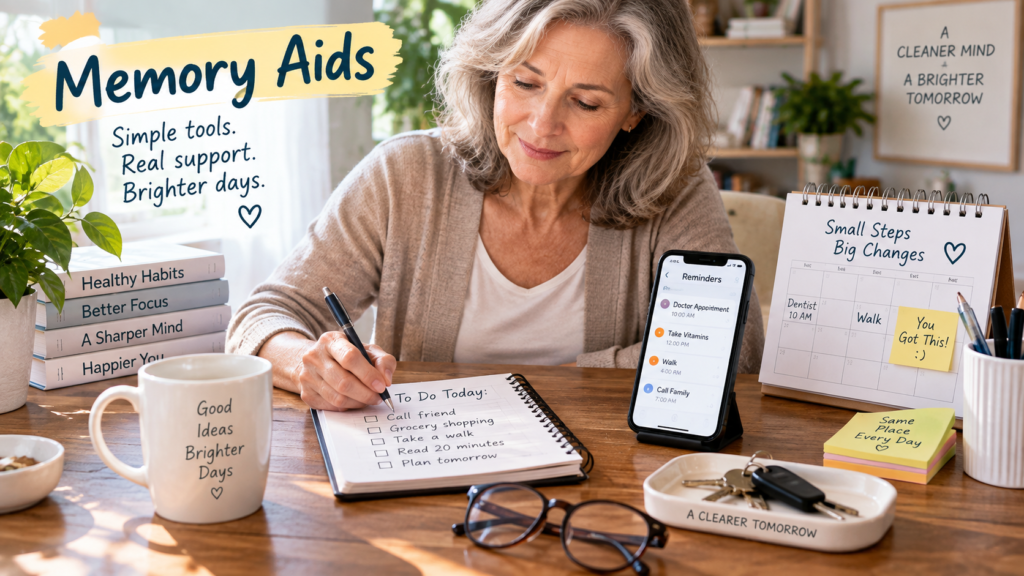
How Memory Aids Can Support Everyday Memory
The goal isn’t to create a life where you never forget anything.
Nobody remembers everything.
Instead, useful memory aids can make everyday life a little easier — remembering appointments, keeping track of tasks, finding important items, staying organized, or reducing the frustration that comes with mental clutter.
Mayo Clinic recommends practical steps including physical activity, mental stimulation, social interaction, and staying organized with calendars, notebooks, and electronic planners.
The Surprising Thing About Memory Aids
Here’s the part that becomes obvious when you actually compare the different options:
“Memory support” doesn’t mean the same thing everywhere.
Some products focus on memory and forgetfulness.
Others focus more on brain fog, concentration, or mental clarity.
Some revolve around ingredients such as Lion’s Mane or Bacopa. Others take a completely different route through digital audio.
That means simply asking, “Which one is best?” isn’t particularly helpful.
A better question is:
“What problem is this option actually trying to address, and is that the kind of approach I’m interested in?”
That small change makes the whole landscape easier to understand.
16 Memory Aids & Brain Health Options to Explore
We looked across different types of products and narrowed the list to options with a reasonably clear focus or a noticeably different approach.
This isn’t a ranking, and it isn’t a claim that any product is right for everyone.
The purpose is simpler: to save you some research time and make it easier to see what each option is actually about.
Phytomem One
Phytomem One is positioned around memory, forgetfulness, brain fog, and word-finding concerns. Its messaging is aimed particularly at people who feel everyday mental slips are becoming more noticeable.
If memory and recall are your main interests, this is one option worth exploring.
Neuro Serge
Neuro Serge takes a different angle, with more emphasis on brain fog, concentration, and mental clarity.
That may make it more interesting to someone whose main frustration isn’t forgetting an appointment, but feeling mentally scattered or having trouble staying focused.
Pineal Guardian X
Pineal Guardian X uses a more curiosity-driven approach centered around the pineal gland and broader brain-health themes.
It’s quite different from a conventional memory-focused formula, so understanding its particular approach is more useful than simply comparing it with every other product on the list.
NeuroVera
NeuroVera is positioned as a broader brain-health formula containing ingredients such as Lion’s Mane, Bacopa, Gotu Kola, Schisandra, and Shilajit.
Rather than centering on one ingredient, its appeal is the combination of several ingredients commonly discussed in the cognitive-health space.
ROAR Lion’s Mane
ROAR takes a more specific route by putting Lion’s Mane at the center of its positioning.
It may appeal to people interested in exploring a mushroom-based approach while focusing on areas such as memory, focus, mental clarity, and brain fog.
Neura
Neura takes a broader approach to memory, focus, mental energy, and cognitive function.
Its formula includes Lion’s Mane, Goji Berry, Bacopa, and Shilajit, giving readers another multi-ingredient option to investigate.
Brain C-13
Brain C-13 is positioned around cognitive function, memory recall, quick thinking, and mood.
Its formula includes ingredients such as Saffron and Huperzine-A, giving it a different formulation from the mushroom-centered choices above.
CogniCare Pro
CogniCare Pro focuses on memory, focus, mental clarity, and brain fog, with ingredients including Bacopa Monnieri and Ginkgo Biloba.
For readers interested in more traditional cognitive-support ingredients, it offers another approach to compare.
Neuro-Thrive
Neuro-Thrive is another option to explore, although publicly available information is less complete than for some of the other choices here.
That’s a reason to look carefully at the current product information rather than assuming that similar products make the same claims.
Mindoxa
Mindoxa takes a broader brain-health approach built around functional mushrooms.
It may be interesting to people who already have an interest in mushroom-based products but want something broader than a single-ingredient formula.
ZenCortex
ZenCortex is different from most of the options here because its positioning centers more on hearing health than memory itself.
It’s included as a related healthy-aging option rather than as a direct equivalent to the other cognitive products.
Java Brain
Java Brain is another product where the current offer and product information deserve a closer look before drawing conclusions.
Rather than making assumptions, the useful first step is understanding exactly what the current program provides.
The Memory Wave
The Memory Wave takes a completely different route from supplements.
It’s a digital audio program built around short listening sessions and marketed around focus, mental clarity, and Gamma brainwave activity.
For someone interested in a non-supplement approach, the format itself may be what makes it interesting.
Neuro Energizer
Neuro Energizer is also digital, using binaural beats and isochronic tones rather than a nutritional formula.
Its positioning is more closely connected to focus, relaxation, and mental energy, particularly for people who prefer short listening sessions.
The Genius Switch
The Genius Switch uses brainwave audio, including Gamma 40 Hz and isochronic tones.
Its positioning centers more on concentration, mental clarity, and reducing distractions than on being another traditional memory supplement.
Genius Brain Signal
Genius Brain Signal takes another digital-audio approach using brainwave and binaural-beat concepts around focus and concentration.
It may appeal to people looking for something they can use before periods of focused work or mental activity.
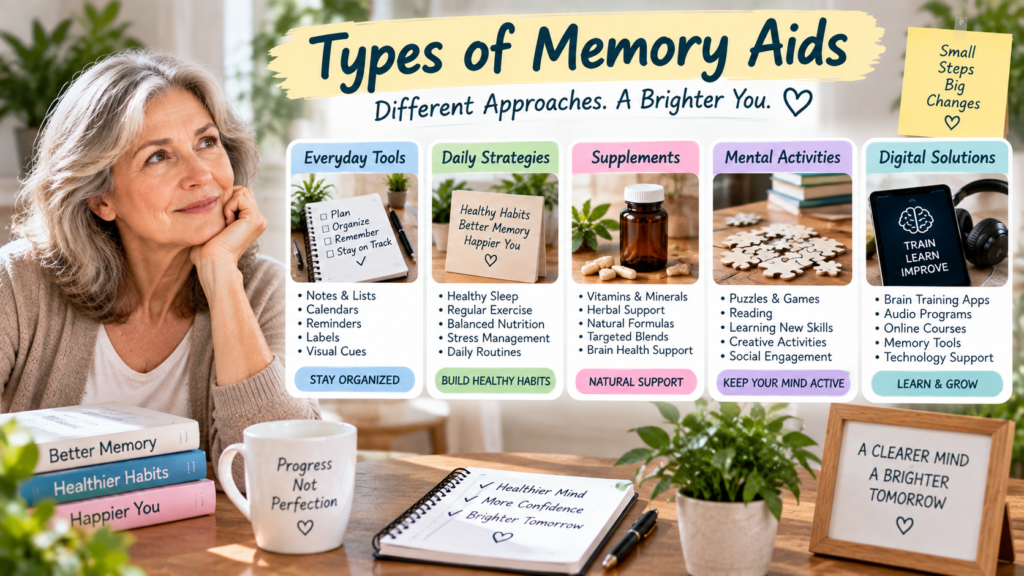
Different Types of Memory Aids
Once you step back, the picture becomes much clearer.
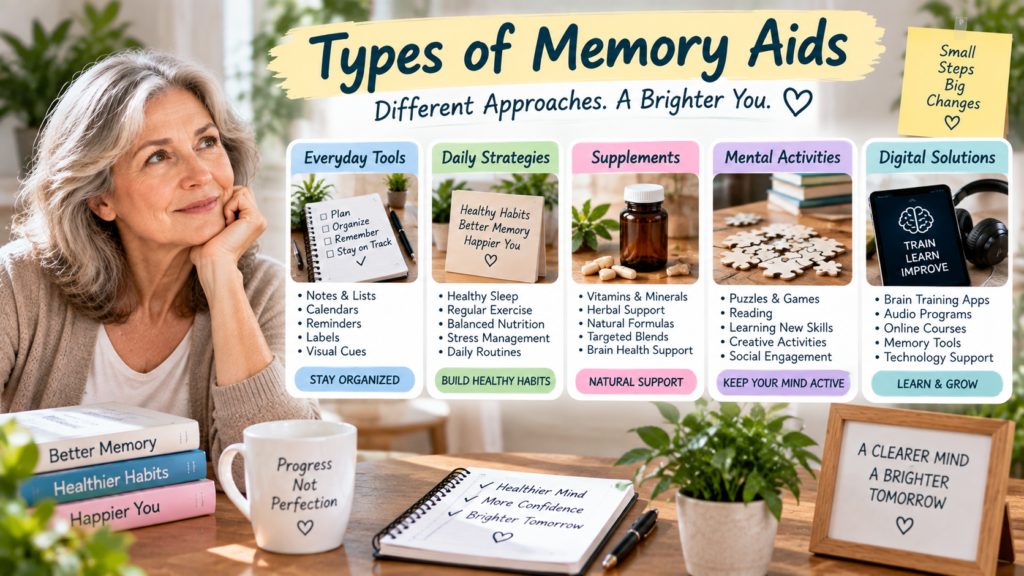
There are everyday memory aids such as calendars, notes, reminders, routines, and technology.
There are lifestyle and cognitive approaches involving physical activity, mental stimulation, social connection, sleep, and healthy eating.
And there are commercial options, including supplements and digital programs that are marketed around memory, focus, or brain health.
These categories shouldn’t be treated as interchangeable. They are simply different ways of approaching the same broad concern: making everyday thinking, remembering, or staying organized easier.
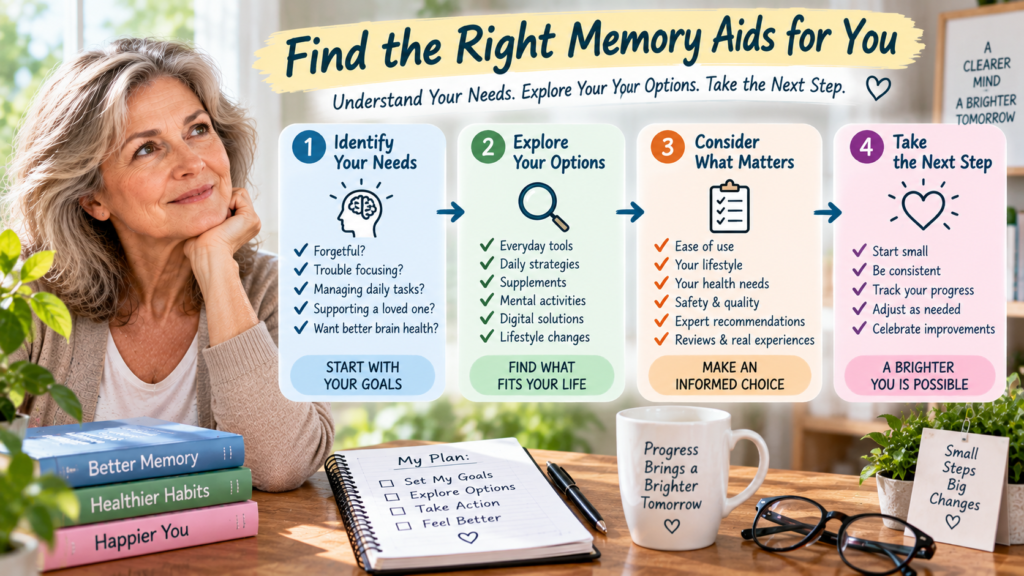
How to Explore Memory Aids for Your Needs
Start with the problem, not the product.
Are you trying to remember appointments? Stay organized? Deal with occasional brain fog? Improve your ability to concentrate? Or are you simply interested in healthy aging?
Once you know that, the choices become much less overwhelming.
Someone who struggles with organization may benefit most from simple tools and routines. Someone curious about nutritional approaches may want to investigate a particular formula. Someone who doesn’t want another supplement may prefer exploring digital options.
That’s the real value of comparing memory aids side by side: you can stop looking at everything as if it were the same thing.
{ → memory aids for mild cognitive impairment }
What to Consider Before Choosing a Memory Aid
One important distinction is easy to miss:
Marketing is not the same as evidence.
The NIA advises caution with unproven products that claim to improve memory or prevent dementia. Supplements can have safety issues, waste money, or interact with medications. NIA also notes that no vitamin or supplement is currently recommended for preventing Alzheimer’s disease or cognitive decline.
So look at what a product actually contains, what it is designed for, what evidence exists, and whether it makes sense for your circumstances.
And if memory changes become persistent, worsen, or interfere with everyday activities, that’s a reason to speak with a healthcare professional rather than simply trying to solve the problem with a product.
Common Questions About Memory Aids
What Are Five Brain Exercises That Can Improve Memory?
There isn’t one magic exercise. Reading, learning a new skill, playing mentally engaging games, learning an instrument, and taking up a new hobby are examples of activities Mayo Clinic recommends for staying mentally active.
What Are the Three Main Foods That Support Memory and Brain Health?
There isn’t a proven three-food formula. Research has explored foods such as leafy greens, berries, and fish, as well as broader Mediterranean- and MIND-style eating patterns, but no individual food has been proven to prevent Alzheimer’s or age-related cognitive decline.
What Does Mayo Clinic Recommend for Memory Loss?
Mayo Clinic highlights physical activity, mental activity, social interaction, staying organized, healthy eating, adequate sleep, and managing health conditions as practical areas to pay attention to.
When Should Memory Loss Be Checked by a Doctor?
If changes in memory or thinking are persistent, concerning, or begin interfering with everyday activities, talk with a healthcare professional. Memory problems can have many possible causes, and finding the cause matters.
Final Thoughts
The more you look at memory aids, the more obvious one thing becomes: there isn’t one universal category and there isn’t one universal answer.
Some people may need nothing more complicated than a better routine, a calendar, or a reminder system.
Others may want to explore cognitive activities, nutritional formulas, or digital programs simply because a particular approach interests them.
And that’s the useful part of having the whole picture in front of you.
You don’t need to keep searching just to understand what memory aids are, what types exist, or why these options are different.
Now you have the map.
You can see the simple everyday tools, the lifestyle approaches, the different product categories, and the specific options that take their own paths.
If one caught your attention, that’s the next thing worth exploring — not because you have to choose it, but because now you know why you’re looking at it.