


How Old to Be Considered a Senior Citizen?
If you’re wondering how old to be considered a senior citizen, you might expect a simple answer: 65. But in the United States, the reality is a little more complicated.
Some people start receiving senior discounts at 50 or 55. Others use 60 as their cutoff. Age 62 matters for Social Security, while 65 is a major Medicare milestone.
So, what age is considered a senior citizen? The answer depends on what you mean by “senior.” Once you understand the different age thresholds, the confusion becomes much easier to sort out.
What Age Is Considered a Senior Citizen?
There isn’t one universal age that automatically makes someone a senior citizen for every purpose in the U.S.
In everyday conversation, 65 is one of the most commonly recognized senior-age milestones. However, that doesn’t mean every business, government program, or organization uses 65 as its cutoff.
If you’re asking how old to be considered a senior citizen, the better question is: “Senior for what?”
A restaurant might offer a senior discount starting at 55. A community program might use 60. Another organization might use 65.
That distinction matters because being considered a senior by one organization doesn’t automatically make you eligible for every senior benefit.
{ → when are you considered a senior citizen }
Is 50, 55, 60, 62, or 65 Considered Senior?
Here’s where the answer gets more interesting. Several different ages can be important, but they don’t all mean the same thing.
Is 50 Considered a Senior Citizen?
Generally, turning 50 does not mean you are automatically classified as a senior citizen across the United States.
However, some private businesses and organizations may begin age-based discounts or programs at 50.
So if you’re 50, it’s worth checking individual offers rather than assuming you’re either too young or automatically eligible.
Is 55 Considered a Senior Citizen?
Age 55 is another common threshold for certain senior discounts and programs.
Some businesses choose 55 as their minimum age because they define their senior customers differently from government programs.
This is why how old to be considered a senior citizen doesn’t have one answer that works everywhere.
If a business says its senior discount begins at 55, then you qualify according to that business’s policy. Another business may use 60 or 65.
Is 60 Considered a Senior Citizen?
At 60, you may find more senior-focused programs and services becoming available.
But again, there is no nationwide rule saying every 60-year-old automatically qualifies for every senior program.
The senior citizen age in the USA is better understood as a range of commonly used thresholds rather than one universal birthday.
Is 62 Considered a Senior Citizen?
Age 62 is particularly important because it is associated with Social Security retirement benefits.
But don’t confuse Social Security eligibility with the general definition of a senior citizen.
For people attaining age 62 in 2026, the Social Security Administration states that full retirement age is 67. That doesn’t mean someone isn’t a senior at 62; it simply shows that Social Security has its own age rules.
Is 65 Considered a Senior Citizen?
For many Americans, 65 is the age most strongly associated with becoming a senior.
One major reason is Medicare. Most people become eligible for Medicare around age 65, although specific circumstances can affect eligibility.
That connection helps explain why 65 is such a familiar answer when people ask how old to be considered a senior citizen.
But even at 65, you should still check the rules for whatever benefit, discount, or service you’re interested in.
Senior Citizen Age in the USA: Why It Varies
The senior citizen age in the USA can vary because different organizations are answering different questions.
Think about three people:
One person wants a restaurant discount.
Another wants to know when Medicare begins.
A third wants to know when they can claim Social Security retirement benefits.
All three are asking about age, but they’re asking about different systems.
That’s the surprising part: there isn’t necessarily a contradiction between someone being considered a senior at 55 and another program using 65.
They’re simply using different eligibility rules.
{ → sr citizen age }
What Age Qualifies for Senior Discounts?
If you’re searching for the senior discounts age, don’t assume that 65 is automatically the answer.
Senior discounts are usually determined by the business or organization offering them.
One company may choose 55. Another may choose 60. Another may use 65. Some businesses don’t offer a senior discount at all.
This means the easiest way to find out whether you qualify is to check the specific company’s policy.
What Senior Discounts Can You Get at 50?
There is no nationwide requirement that businesses give senior discounts to people starting at age 50.
However, if a business voluntarily sets its senior discount at 50, then someone who has reached that age may qualify under that policy.
The same principle applies at 55 or 60.
So when searching for how old to be considered a senior citizen, remember that a discount age is not necessarily the same thing as a general definition of seniorhood.
Senior Citizen Benefits: What Changes With Age?
The phrase senior citizen benefits can sound like there is one big package of benefits that starts on a specific birthday.
That’s not really how it works.
Different programs have different eligibility requirements, and age may be only one factor.
Social Security
Social Security has its own retirement benefit rules, including rules concerning when benefits can begin and when someone reaches full retirement age.
That’s separate from the everyday meaning of “senior citizen.”
Medicare
Medicare is one of the biggest reasons age 65 is so important.
Medicare.gov explains that most people can sign up for Medicare when they become eligible around age 65, with specific enrollment rules and exceptions.
Other Programs and Services
Local governments, nonprofit organizations, senior centers, transportation programs, and community services can establish their own age requirements.
That’s why checking the actual eligibility rules is more useful than relying on a single definition.
Senior Citizen vs. Older Adult vs. Elderly
You may also notice that organizations use different terms for older Americans.
You might see:
- Senior citizen
- Older adult
- Older Americans
- Elderly

These terms aren’t necessarily tied to exactly the same age.
“Older adult,” for example, is commonly used in health and research settings, while “senior citizen” is often used in everyday conversation, services, and marketing.
So if you’ve been searching how old to be considered a senior citizen, don’t assume that another term automatically has the same age cutoff.
{→ at what age you are considered senior citizen}
Is There an Official Senior Citizen Age?
This is the part that clears up most of the confusion.
There isn’t one universal senior citizen age that applies to every situation in the United States.
Age 65 is a major milestone and is widely associated with seniorhood. But some discounts and programs begin earlier, while other benefits have their own specific requirements.
Instead of asking only, “Am I a senior?”
ask:
“What age does this particular program or business use?”
That small change in the question can give you a much more useful answer.
How Old Do You Have to Be to Be a Senior Citizen?
So, how old to be considered a senior citizen?
For general everyday use, 65 is one of the most widely recognized answers in the United States.
But 50, 55, and 60 may qualify someone for certain private discounts or programs. Age 62 has an important connection with Social Security, while 65 is closely connected with Medicare eligibility.
The important thing is to separate the general idea of being a senior from eligibility for a specific benefit.
{ → at what age do you become a senior citizen }
Frequently Asked Questions
Is 55 years old considered a senior citizen?
It can be for certain businesses, organizations, or programs. However, 55 is not a universal senior-citizen cutoff for every situation in the U.S.
Is 60 considered a senior citizen?
Age 60 may qualify you for some senior programs or discounts, depending on the organization’s eligibility rules.
Is 65 considered a senior citizen?
Yes, 65 is one of the most commonly recognized senior-age milestones in the United States. It is also an important age for Medicare eligibility.
What age is considered a senior citizen for discounts?
There is no single senior discounts age. Each business or organization can establish its own minimum age.
What do 60-year-olds get free?
There is no nationwide package of free benefits automatically available to every 60-year-old. Eligibility depends on the specific program and its rules.
Does Social Security define you as a senior citizen?
No. Social Security establishes rules for retirement benefits, but those rules are not a universal definition of “senior citizen.”
What age is considered a senior citizen in the U.S.?
There is no single age that applies to every situation. Age 65 is a widely recognized milestone, but individual programs and businesses may use different thresholds.
The Bottom Line
If you’ve been asking how old to be considered a senior citizen, the answer isn’t as simple as picking one birthday.
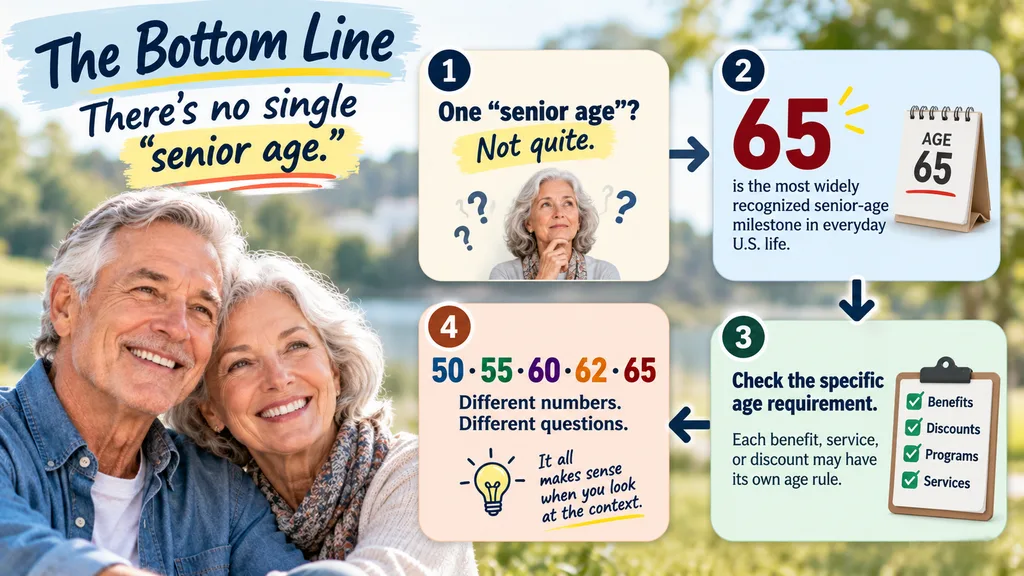
65 is the most widely recognized senior-age milestone in everyday U.S. life, but it isn’t a universal cutoff for every discount, program, or benefit.
That means someone in their 50s or early 60s shouldn’t automatically assume they don’t qualify for something described as “senior.”
The smartest approach is simple: find the age requirement for the specific benefit, service, or discount you’re interested in.
Once you look at it that way, the different numbers—50, 55, 60, 62, and 65—stop looking contradictory.
They simply answer different questions.
But getting older is about more than a number. For many people, it also means paying closer attention to memory, focus, and mental clarity—and to the everyday habits that support healthy aging.
That raises a natural next question: what role might nutrition and functional mushrooms play in brain health as we get older?