

Memory Aids: Types, Examples, and How to Choose the Right One
Forgetting an appointment or misplacing your keys happens to everyone. But when memory problems start making everyday tasks harder, having a simple way to keep track of things can make life feel a little more manageable.
That is where memory aids can help.
A memory aid might be something as simple as a calendar, a written reminder, or a checklist. It could also be a memory book, a phone alarm, or a mental technique that makes information easier to recall.
The trick is not finding the most complicated tool. It is finding something that solves the particular memory problem you are dealing with—and is easy enough to use every day.
What Are Memory Aids?
Memory aids are tools and techniques that help people remember information, stay organized, or manage everyday tasks.
Some work outside the mind, such as calendars, notes, labels, and phone reminders. Others use mental strategies, such as repetition, association, visualization, or mnemonics.
For example, writing a doctor’s appointment on a calendar means you do not have to keep remembering the date throughout the day. Keeping your keys in the same place every evening can make them easier to find the next morning.
Memory aids can be useful for adults of different ages, including older adults and people experiencing changes in memory or thinking.
What Are Some Examples of Memory Aids?
There are plenty of options, and many of them are surprisingly simple.
Common examples include:
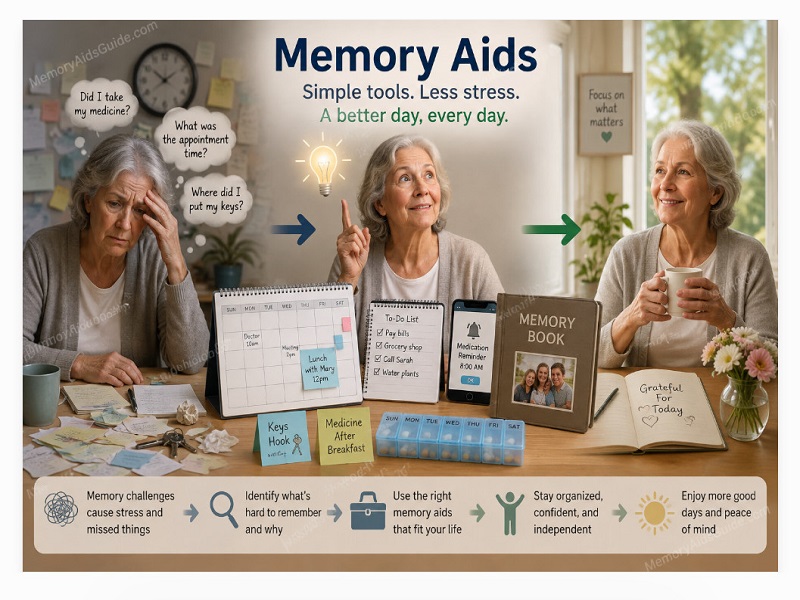
Calendars and planners for appointments and important dates
To-do lists for everyday tasks
Written notes for reminders and instructions
Checklists for routines with several steps
Labels for drawers, cupboards, and frequently used items
Alarms and timers for appointments or activities
Medication reminders for keeping track of schedules
Memory books containing photographs, names, and familiar information
Phone reminders and apps for tasks and appointments
Visual cues that remind someone what to do or where something belongs
Designated places for important items such as keys, glasses, or a wallet
A person who regularly forgets appointments may need nothing more than a large calendar.
Someone who loses their keys every day might benefit more from keeping them in one specific place near the door.
That is an important point: the most useful memory aid is the one that matches the problem.
What Are the Different Types of Memory Aids?
Memory aids generally fall into two broad groups: internal memory aids and external memory aids.
Internal Memory Aids
Internal memory aids use mental techniques to make information easier to remember.
Some examples are:
Repetition
Association
Visualization
Grouping information into smaller pieces
Mnemonics
Connecting new information with something familiar
For instance, someone learning a new name might connect it with a familiar image or characteristic. Another person might repeat a new piece of information several times to make it easier to recall later.
These techniques can be particularly useful when you want to remember something without having to check a written reminder.
External Memory Aids
External memory aids put information somewhere outside your memory so you can refer to it later.
Calendars, notebooks, lists, labels, memory books, alarms, and smartphone reminders all fit into this group.

For someone who keeps forgetting appointments, a calendar may be more useful than trying to memorize every date. For someone who struggles with a morning routine, a short checklist may be easier to follow.
Do Memory Aids Really Work?
They can be helpful, but it is worth being clear about what they are designed to do.
A memory aid does not necessarily fix the underlying cause of memory loss. Instead, it gives you another way to keep important information available.
Think about a shopping list. You could try to remember ten items while walking around the store, or you could write them down and check the list as you go.
The list has not improved your memory. It has simply taken some of the pressure off it.
The same idea can apply to appointments, daily routines, medication schedules, names, instructions, and other information that is easy to forget.
So instead of asking only, “Will this improve my memory?”, a more useful question may be:
“Will this make the thing I keep forgetting easier to manage?”
For many everyday situations, that is the real value of a memory aid.
What Memory Aids Can Help Seniors and People With Dementia?
Memory Aids for Seniors
For older adults, simple tools are often a good starting point.
A large, easy-to-read calendar may be more practical than a complicated app. A notebook kept in the same place every day may work better than a reminder system that requires several steps.
Simple environmental cues can help too. Keeping glasses on the same table every night or putting keys in one designated spot reduces the amount of searching involved in everyday life.
Memory Aids for Dementia
For someone living with dementia, familiar routines and clear visual reminders may become especially useful. Depending on the person’s needs, this might include:
Large calendars
Simple written instructions
Labels
Memory books with photographs and names
Familiar visual cues
Consistent routines
Medication reminders
Simple day-and-date displays
The important thing is not to overwhelm the person with reminders. A few clear cues may be easier to use than a room full of signs, notes, and instructions.
Memory Aids for Mild Cognitive Impairment
If memory changes are affecting someone with mild cognitive impairment, tools such as daily lists and reminders may also be useful for supporting everyday tasks.
Alzheimer’s Memory Aids
For people with Alzheimer’s disease, familiar information, photographs, names, and routines can also become valuable forms of support.
How Do You Choose the Right Memory Aid?
Start with the problem, not the product.
Ask yourself:
What does the person keep forgetting?
When does it usually happen?
Would a written, visual, mental, or digital reminder be easiest?
Can the person use it independently?
Will it fit naturally into their daily routine?
If appointments are the problem, try a calendar.
If several daily tasks are easily forgotten, try a short checklist.
If belongings keep disappearing, create one consistent place for them.
If names and relationships are becoming difficult to remember, a simple memory book with photographs may be more useful.
Start with one problem. Try one simple solution. If it helps, keep it. If it creates more confusion, change it.
There is no prize for having the most sophisticated memory aid.
Frequently Asked Questions
What are some examples of memory aids?
Calendars, planners, to-do lists, written notes, checklists, labels, memory books, alarms, phone reminders, and consistent routines are common examples. Mental techniques such as repetition and mnemonics can also help with remembering information.
Do memory aids really work?
They can make everyday tasks easier by keeping important information available or providing reminders when they are needed. Their usefulness depends on the person’s needs and whether the aid is simple enough to use consistently.
What is an internal memory aid?
An internal memory aid is a mental strategy used to make information easier to remember. Examples include repetition, visualization, association, grouping, and mnemonics.
What are memory aids for dementia?
Memory aids for dementia can include calendars, memory books, photographs, labels, simple instructions, visual cues, and familiar routines. They should be adapted to the person’s abilities and kept as simple as possible.

The Bottom Line
Memory aids do not have to be complicated.
Sometimes the answer is a calendar. Sometimes it is a checklist, a memory book, a phone reminder, or simply putting an everyday item in the same place every time.
Start with the memory problem that causes the most frustration and choose the simplest aid that could make it easier.
And if memory problems are becoming more frequent, getting worse, or interfering with everyday life, a memory aid can provide practical support—but it should not replace appropriate professional advice about the underlying cause.
The right memory aid is not necessarily the newest tool or the most advanced technology.
It is the one that makes everyday life easier for the person using it.
Sometimes, simple memory aids are enough to make everyday life feel easier. But when forgetfulness, brain fog, or difficulty finding the right words raises bigger questions, it may be worth exploring other ways to support memory and mental clarity.
Curious about another approach? Explore one option we have reviewed and see what makes it different.