

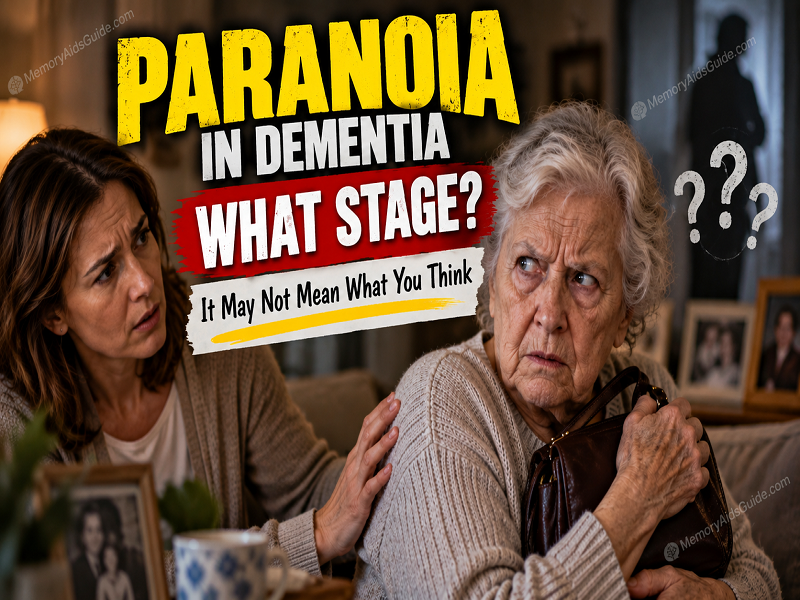
What Stage Is Paranoia in Dementia? 7 Warning Signs
If someone you love has started accusing family members of stealing, hiding things, or trying to hurt them, you may be searching what stage is paranoia in dementia because you want to know what comes next.
The short answer: paranoia is often associated with the middle to later stages of dementia, especially Alzheimer’s disease. But what stage is paranoia in dementia does not have one fixed answer. Paranoia can appear at different points and should not be used alone to determine a person’s stage.
What Stage Is Paranoia in Dementia?
The Alzheimer’s Association says delusions and suspicious beliefs may occur in middle- to late-stage Alzheimer’s. Examples include believing someone has stolen possessions or is following the person.
So, if you are asking what stage is paranoia in dementia, think “middle to later stages” rather than a specific stage number.
That distinction matters because dementia progresses differently from person to person.
What Does Dementia Paranoia Look Like?
One reason dementia paranoia symptoms can be difficult for families is that the belief may sound unreasonable to everyone else while feeling completely real to the person experiencing it.
Common examples include:
- “Someone stole my wallet.”
- “You are hiding my money.”
- “You are not really my daughter.”
- “Someone is coming into the house.”
- “The caregiver is trying to trick me.”
- “My spouse is seeing someone else.”
The National Institute on Aging explains that paranoia in Alzheimer’s is often linked to memory loss. If a person cannot remember where an item was placed, they may conclude that someone took it.
That is one of the most important insights for caregivers:
The belief may be false, but the fear is real.
7 Warning Signs to Watch For
If you are wondering what stage is paranoia in dementia because behavior has recently changed, watch for patterns rather than one isolated incident.
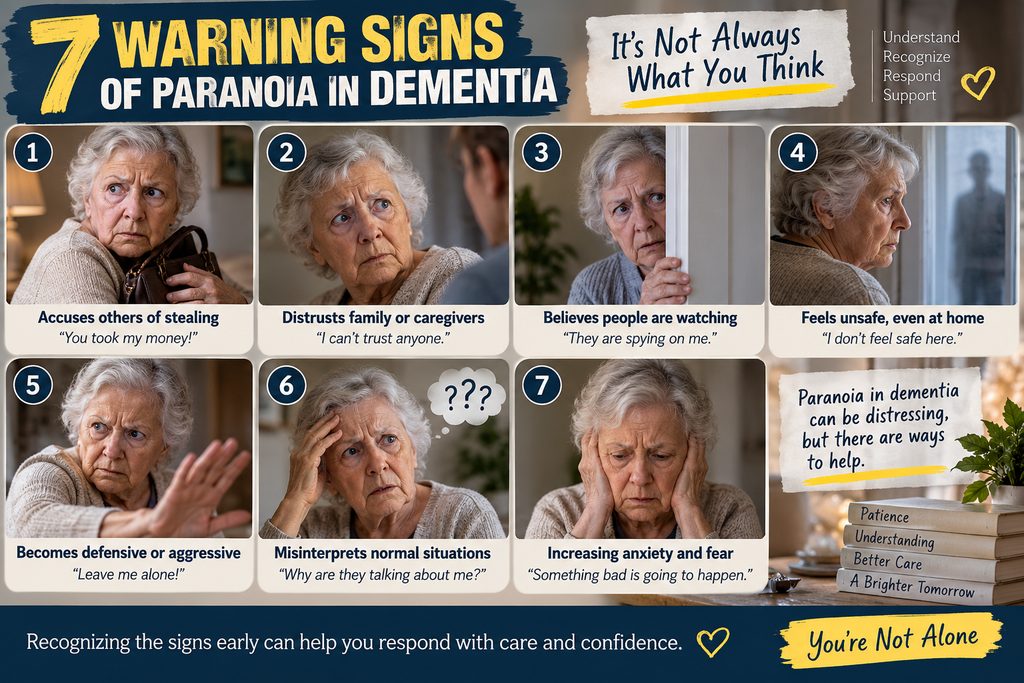
Seven common signs include:
- Repeated accusations that someone stole something.
- Suspicion toward a familiar caregiver.
- Fear that someone wants to cause harm.
- Jealous or unfounded accusations toward a spouse.
- Repeated searching for missing belongings.
- Sudden distrust of people who were previously trusted.
- Increasing fear or agitation around ordinary situations.
These signs can occur with dementia, but they cannot tell you the exact stage alone. The CDC notes that dementia symptoms vary widely and can affect memory, communication, judgment, reasoning, and daily functioning.
Why Does Dementia Cause Paranoia?
Here is the surprising part: paranoia may sometimes be the brain’s attempt to explain information it can no longer process correctly.
Imagine someone puts their glasses somewhere and immediately forgets where they left them. They search, cannot find them, and cannot remember putting them down. “Someone took them” may feel more believable than “I forgot.”
The NIA explains that paranoia may be connected to memory loss, and a person may blame or accuse others when no other explanation seems to make sense.
Is Paranoia Part of Early Dementia?
Can paranoia happen early? Yes. But what stage is paranoia in dementia cannot be answered by saying “early,” “middle,” or “late” based on paranoia alone.
If you are still unsure what stage is paranoia in dementia, look at the bigger picture. Can the person still manage everyday activities? Are they becoming lost? Do they need more help with medication, dressing, meals, or personal care?
Those broader changes provide more useful information about progression than one behavior.
Vascular Dementia and Paranoia
Vascular dementia and paranoia can occur together, but there is no universal rule saying paranoia begins at one particular vascular dementia stage.
Vascular dementia can affect thinking, judgment, attention, and behavior differently depending on which areas of the brain are affected. That is one reason what stage is paranoia in dementia can vary from one person to another.
{→ vascular dementia and paranoia }
Lewy Body Dementia and Paranoia
Lewy body dementia and paranoia deserve special attention because LBD can involve delusions, misperceptions, hallucinations, and behavioral changes.
The NIA lists paranoia among possible behavioral symptoms of LBD, including suspicion that people are taking or hiding belongings.
{ → 7 stages of lewy body dementia }
Why Does Dementia Cause Paranoia About Money?
A person may forget a payment, misplace cash, misunderstand a bank transaction, or forget a conversation. They may then conclude that a family member stole the money.
That is why dementia and paranoia about money can become emotionally explosive. Arguing over the facts may not solve the problem because the person is reacting to a reality that feels genuine to them.
How to Deal With Paranoia in Dementia Patients
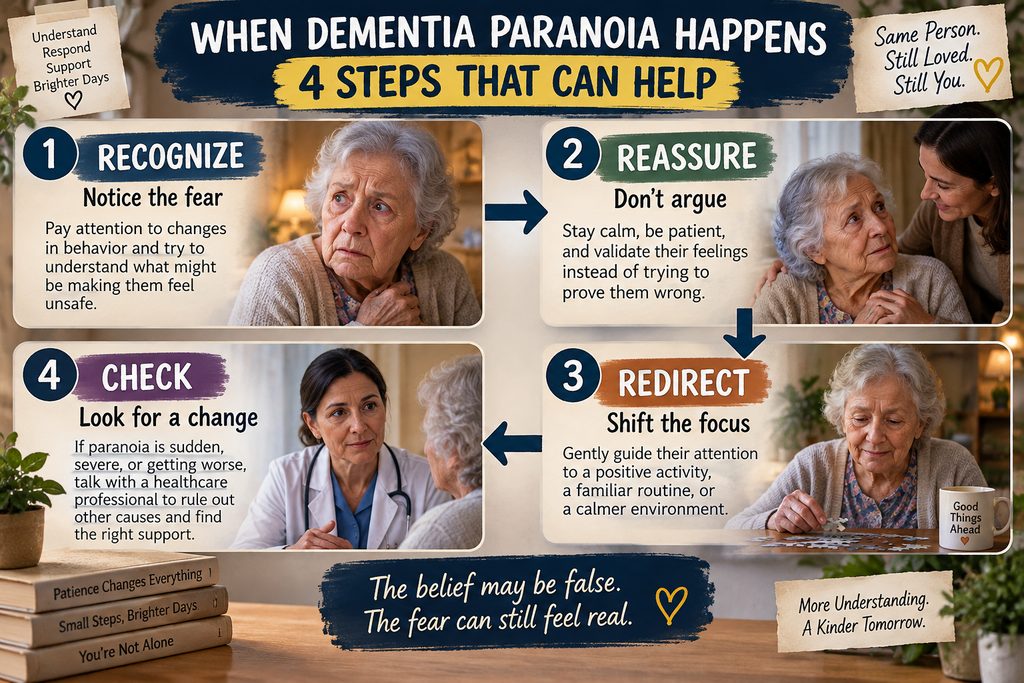
If you are wondering what stage is paranoia in dementia while trying to help, remember that the goal is not to “win” the argument. The goal is to reduce fear and restore a sense of safety.
When learning how to deal with paranoia in dementia patients, try these five steps:
1. Do not argue
Saying “That never happened” may feel logical, but it often does not remove the fear.
2. Respond to the emotion
Try:
3. Keep explanations simple
Long explanations can create even more confusion.
4. Redirect gently
Move to another room, look at photographs, offer a familiar activity, or talk about something comforting.
5. Look for the trigger
Ask what happened immediately before the suspicious behavior started. Was something missing? Did the environment change? Was the person tired or overwhelmed?
{ → 20 things not to say to someone with dementia }
How Long Does Paranoia Last in Dementia?
For some people, suspicious thoughts may come and go. For others, they may become recurring.
If you are asking what stage is paranoia in dementia because the behavior suddenly became much worse, do not automatically assume the dementia has simply advanced.
A sudden change deserves medical attention. Illnesses, medications, or other factors can sometimes contribute to hallucinations or delusions.
When Should You Be Concerned?
Contact a healthcare professional when paranoia becomes severe, causes major distress, or creates a risk that the person could hurt themselves or someone else. The Alzheimer’s Association recommends medical evaluation when delusions are extremely troubling or there is concern about harm.
The NIA also notes that suspicious or distrustful behavior in an older adult should not automatically be assumed to be paranoia, because abuse, including financial abuse, can sometimes be involved.
{→ CDC: Signs and Symptoms of Dementia}
The Bottom Line
So, what stage is paranoia in dementia?
Most often, it is associated with the middle to later stages, especially in Alzheimer’s disease. But what stage is paranoia in dementia cannot be determined from paranoia alone. One person may develop suspicious behavior earlier, another later, and some may not experience it at all.
The better question is not only what stage is paranoia in dementia, but what the behavior is communicating.
Once you recognize the fear underneath the accusation, your response can change. Instead of correcting every detail, you can reassure, redirect, reduce triggers, and create a calmer environment.
That can mean fewer arguments, less fear, and a better chance of getting through the difficult moment without damaging trust. And that is the part caregivers can actually do something about.
And that is the part caregivers can actually do something about.
But there is another question worth asking: when memory changes start showing up in everyday life, what else might be going on beneath the surface?
Forgetting a word. Losing a train of thought. Feeling mentally foggy. Small moments like these can be easy to dismiss — until they start happening more often.
If you want to explore that side of memory more deeply, there is a different perspective worth looking into.