


Dementia & Paranoia
Why would someone who has trusted you for years suddenly accuse you of stealing from them?
It can be shocking. You know you did nothing wrong, yet explaining the truth may only make the conversation more tense.
The surprising part is that the accusation may not really be about the missing object. With dementia & paranoia, memory loss and confusion can make an ordinary situation feel like proof that someone cannot be trusted.
Once you understand what is happening, your response can change—and so can the moment itself.
Instead of arguing for 20 minutes, you may be able to reduce fear, find the trigger, and help the person feel safe again.
What Is Dementia & Paranoia?
Imagine putting your glasses on the kitchen counter and then completely forgetting where they went.
You remember that the glasses are missing. You do not remember moving them. Your brain still wants an explanation, so “someone took them” may begin to feel like the only answer.
This helps explain why dementia & paranoia can occur together.
A person may become convinced that someone stole their belongings, is watching them, is lying to them, or wants to hurt them. These beliefs can be related to delusions, while hallucinations are different because they involve sensing something that is not actually present.
The important point is simple: the fear may be real to the person even when the belief is not.
7 Signs of Dementia Paranoia
Not every suspicious behavior means dementia paranoia. But several patterns appearing repeatedly can be a useful signal for caregivers.
1. Accusing Someone of Stealing
A person may say that a family member or caregiver stole money, jewelry, clothes, food, or another possession.
Often, the object has simply been misplaced.
2. Suddenly Distrusting Family
Someone who once trusted you may begin asking whether you are telling the truth or hiding something.
This sudden change can be especially painful for caregivers.
3. Believing Someone Wants to Hurt Them
The person may believe somebody is trying to poison, attack, deceive, or harm them.
Their fear can feel completely genuine.
4. Believing They Are Being Watched
They may think someone is following them, monitoring them, or secretly observing them.
Unfamiliar places can make this feeling stronger.
5. Believing Their Home Is Not Their Home
A person may insist that they are in the wrong house or that strangers have entered their home.
What looks irrational to others may feel completely logical to the person experiencing it.
6. Repeatedly Searching for Missing Things
The same drawer or bag may be searched again and again.
Because memory problems make previous conversations difficult to retain, the same suspicion can return.
7. Becoming Defensive or Angry
Dementia & paranoia can lead to fear, anxiety, withdrawal, anger, or refusal to accept help.
The more threatened the person feels, the harder ordinary caregiving can become.
Is Paranoia a Symptom of Dementia?
Yes, is paranoia a symptom of dementia is an important question because paranoia, suspiciousness, and delusions can occur with several types of dementia.
Alzheimer’s disease can involve paranoia, delusions, and hallucinations. Similar symptoms may occur with vascular dementia and Lewy body dementia.
But dementia & paranoia does not mean that paranoia alone proves someone has dementia.
Medication effects, illness, sensory problems, confusion, and environmental changes can also contribute to suspicious behavior.
So the better question is not simply, “Is this paranoia?”
It is: “What changed, and what might be causing it?”
That shift can help caregivers respond more effectively instead of immediately assuming the worst.
{ Vascular dementia and paranoia }
What Stage Is Paranoia in Dementia?
What stage is paranoia in dementia? There is no single stage when paranoia always appears.
However, paranoid beliefs and delusions are commonly seen during the middle stages of dementia. A person may believe others cannot be trusted, are trying to harm them, or are stealing from them.
Dementia & paranoia can also occur during later stages, while some people may experience these symptoms earlier.
The type of dementia matters too.
So if you are asking what stage is paranoia in dementia, the safest answer is: often the middle stage, but not exclusively.
Why Do Dementia & Paranoia Happen Together?
Here is the part many caregivers find surprising.
Sometimes the person is not reacting to what actually happened. They are reacting to what their brain thinks happened.
Memory loss may erase the moment when an item was moved. Confusion may make a familiar room feel unfamiliar. Hearing or vision problems can make ordinary sounds or sights harder to interpret.
The brain then tries to fill in the missing pieces.
That is one reason dementia and paranoia can become connected.
Medication changes, illness, unfamiliar surroundings, and changes in routine may also contribute.
Understanding paranoia and dementia means looking for the missing piece instead of focusing only on the accusation.
How to Deal With Dementia & Paranoia
This is where caregivers can make the biggest difference.
When dementia & paranoia appear, the instinct is often to prove the person wrong.
But that can create a frustrating cycle:
Accusation → correction → argument → more fear → stronger accusation.
Try changing the pattern.
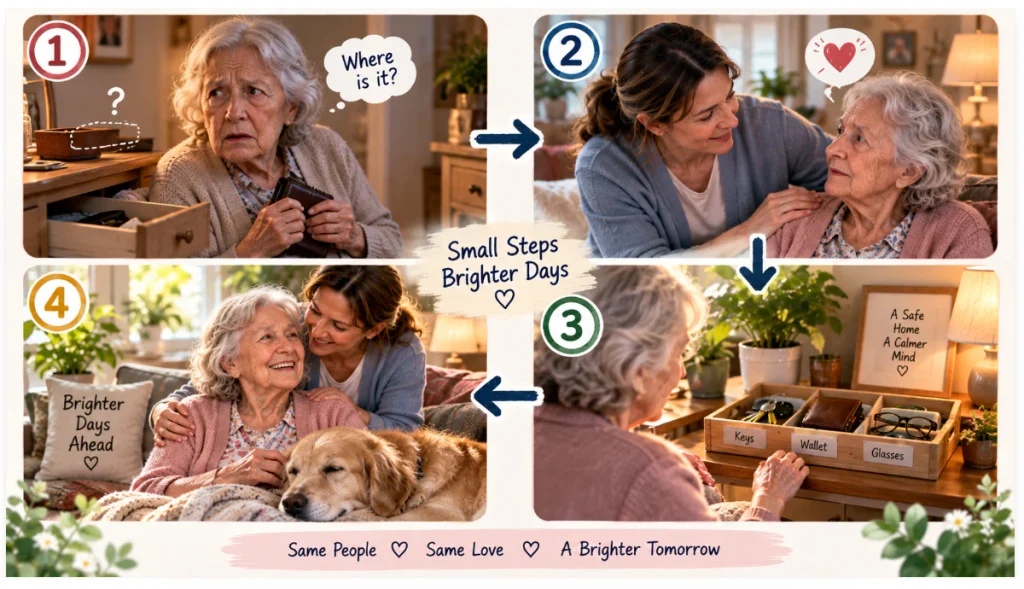
Concern → reassurance → practical help → calmer situation.
Stop Trying to Win the Argument
Imagine someone says:
“You stole my wallet.”
Your natural response might be:
“I did not! I was with you all morning.”
But more evidence does not necessarily create more understanding.
Try:
“That sounds worrying. Let’s look for it together.”

You are not agreeing with the accusation.
You are simply removing the fight.
Look for the Practical Explanation
Check the usual places where the person keeps important belongings.
Create consistent locations for glasses, wallets, keys, medication, and other frequently misplaced items.
Small routines can reduce repeated confusion.
Reduce What Feels Confusing
Good lighting, familiar surroundings, working glasses or hearing aids, and predictable routines may make everyday situations easier to understand.
If a particular time of day repeatedly triggers dementia & paranoia, look for what changes at that time.
Is the room darker? Is the person tired? Are unfamiliar people arriving?
Sometimes the trigger is surprisingly simple.
Redirect Instead of Pushing
If the person remains distressed, change the focus.
A snack, short walk, familiar song, television program, or simple activity can give the brain something new to concentrate on.
{ Useful distraction techniques for dementia caregivers }
The goal is not to make the person “forget” the problem.
The goal is to help them move from fear back toward safety.
What Should Caregivers Avoid?
With dementia & paranoia, what you say can matter as much as what you do.
Try to avoid:
- “You’re imagining things.”
- “That’s ridiculous.”
- “I already told you!”
- Repeatedly demanding proof
- Mocking the accusation
- Becoming angry or defensive
- Making unnecessary changes to familiar surroundings
Instead, acknowledge the emotion without confirming the false belief.
“I can see you’re worried. Let’s work out what happened.”
That one sentence can change the direction of the conversation.
{ 20 things not to say to someone with dementia }
When Should You Talk to a Doctor?
A sudden or major change in dementia & paranoia should not simply be assumed to be “part of dementia.”
Talk with a healthcare professional when paranoia:
- Appears suddenly
- Becomes much more intense
- Causes severe distress
- Leads to aggression or unsafe behavior
- Interferes with sleep, eating, medication, or daily life
- Appears after illness or a medication change
Sudden behavioral changes can sometimes have another medical explanation, including delirium, infection, or medication effects.
And one important reminder: not every accusation is automatically a delusion. If there is a real possibility of abuse, exploitation, or theft, investigate the concern rather than dismissing it.
FAQ About Dementia & Paranoia
Is paranoia a symptom of dementia?
Yes. Dementia & paranoia can occur together, especially when memory, perception, and reasoning are affected. However, paranoia alone does not diagnose dementia.
What stage is paranoia in dementia?
Paranoia and delusions are commonly associated with the middle stages, but dementia & paranoia can occur at different stages depending on the individual and type of dementia.
Is paranoia an early sign of dementia?
It can occur in a person with dementia, but paranoia by itself is not a reliable early diagnostic sign. Other cognitive and behavioral changes should also be considered.
Why does dementia cause paranoia?
Memory loss can make it difficult to remember where something was placed or what happened earlier. The brain may then create an explanation that feels real, leading to suspicion.
How do you deal with paranoia in someone with dementia?
Stay calm, acknowledge the person’s feelings, avoid arguing, look for practical explanations, reduce confusion, and redirect attention when necessary.
Are paranoia, delusions, and hallucinations the same?
No. Paranoia and dementia may involve suspicion or mistrust. Delusions are strongly held false beliefs, while hallucinations involve sensing something that is not actually present.
Final Thoughts
Dementia & paranoia can make ordinary moments feel frightening—for the person experiencing them and for the caregiver standing in front of them.
But there is an important difference between proving someone wrong and helping someone feel safe.
The next time an accusation appears, pause before defending yourself.
Listen to the fear. Look for the trigger. Offer practical help. Then redirect when the moment is no longer productive.
You may not be able to prevent every episode of dementia & paranoia.
But you can change what happens next.
And sometimes, those next few minutes are where the biggest difference begins.
One More Thing Worth Exploring
Not every memory change is dementia. Brain fog, forgetfulness, and trouble finding words can also affect everyday life, especially as we get older.
If you’re curious about another perspective on everyday memory support, Phytomem One is worth exploring.