


20 Things Not to Say to Someone With Dementia: What to Say Instead
Talking to someone with dementia can be hard, especially when you’re tired.
They may ask the same question again and again, forget something you explained a few minutes ago, struggle to find the right words, or become upset over something that seems small. If you’re caring for a loved one, it’s easy to reach a point where you think, “I don’t know what to say anymore.”
That’s understandable.
The goal isn’t to communicate perfectly. It’s to avoid turning a difficult moment into a memory test, an argument, or a source of embarrassment. Understanding the 20 Things Not to Say to Someone With Dementia can help make difficult conversations feel calmer, more respectful, and less stressful for everyone involved.
Here are 20 common things to avoid—and what you can say instead.
20 Things Not to Say to Someone With Dementia
1. “Do you remember?”
This can make a conversation feel like a test.
Try instead: “We went to the park yesterday. We sat by the lake.”
Give the person some context rather than asking them to retrieve the memory. NIA specifically advises against asking whether a person with Alzheimer’s remembers someone or something.
When considering the 20 Things Not to Say to Someone With Dementia, it helps to remember that a conversation should not feel like a test the person is expected to pass.
2. “Do you remember me?”
If they don’t recognize you, this can be painful.
Try instead: “Hi, Mom. It’s Sarah. I’m so happy to see you.”
A warm introduction removes the pressure to prove they remember you.
This approach is an important part of understanding how to talk to someone with dementia without creating unnecessary embarrassment or pressure.
3. “I already told you that.”
Repeated questions can be exhausting for a caregiver, but pointing that out usually doesn’t solve the repetition.
Try instead: Answer briefly again, then gently redirect if necessary.
Repeated questions are one of the most common communication challenges addressed by the 20 Things Not to Say to Someone With Dementia.
4. “You just asked me that.”
The question may be repetitive to you but completely new to the person with dementia.
Try instead: Simply answer again.
Sometimes the kindest response is also the shortest one.
5. “Don’t you remember?”
This can make someone feel ashamed about memory loss they cannot simply control.
Try instead: Give them the information they need: “Your daughter is coming this afternoon.”
Avoiding phrases like these is one reason the 20 Things Not to Say to Someone With Dementia can be useful for caregivers facing difficult conversations every day.
6. “That happened a long time ago.”
Correcting the timeline may matter less than understanding why the person is telling you the story.
Try instead: “Tell me about that.”
If the exact date isn’t important, focus on the memory and the feeling behind it.
7. “You’re not making any sense.”
Dementia can affect finding words, following longer conversations, and keeping a thought organized.
Try instead: “Take your time. What are you trying to tell me?”
Pause and give the person extra time to respond.
This is one of the most important lessons behind the 20 Things Not to Say to Someone With Dementia: difficulty finding the right words does not mean the person’s thoughts or feelings do not matter.
8. “You need to calm down.”
Telling someone to calm down rarely makes an upsetting moment disappear.
Try instead: “You seem upset. I’m here with you.”
A calm voice and reassurance can be more useful than an instruction.
The 20 Things Not to Say to Someone With Dementia become especially important during emotional moments, when a few words can either reduce distress or unintentionally make the situation worse.
9. “There’s nothing to be afraid of.”
The fear may feel very real to the person, even when you don’t see a reason for it.
Try instead: “You’re safe. I’m right here.”
You can acknowledge the emotion without arguing about whether the fear makes sense.
10. “You’re wrong.”
Correcting every mistake can turn communication into a battle.
Try instead: Ask yourself whether the mistake actually matters. If it doesn’t affect safety, respond to the concern behind the words.
NIA recommends listening to concerns and avoiding arguments.
This is another reason why the 20 Things Not to Say to Someone With Dementia are not simply a list of forbidden phrases—they can help caregivers recognize communication mistakes before an argument becomes more stressful.
11. “That’s not what happened.”
The person may remember an event differently from you.
Try instead: “Tell me what you remember.”
When correcting the detail isn’t necessary, letting it go can keep the conversation calmer. NIA also advises family and friends not to correct or argue over mistakes unnecessarily.
12. “You can do this yourself.”
A task that was once easy may now be difficult.
Try instead: “Let’s do this together.”
Offer help without automatically taking away the person’s involvement or independence.
The 20 Things Not to Say to Someone With Dementia also remind caregivers that offering support does not have to mean taking away a person’s dignity or independence.
13. “Good boy!” or “Good girl!”
Even when intended affectionately, this can sound patronizing when speaking to an adult.
Try instead: “You did that really well.”
NIA advises against “baby talk” or a “baby voice” when communicating with someone with Alzheimer’s.
Respectful dementia communication means continuing to treat the person as an adult, regardless of changes in memory or ability.
14. “You’re being difficult.”
This labels the person instead of asking what might be behind the behavior.
Try instead: Look for the need underneath it.
Are they tired, uncomfortable, hungry, frightened, or overwhelmed?
Looking beneath the behavior is often more helpful than assigning blame, which is another important theme throughout the 20 Things Not to Say to Someone With Dementia.
15. “Stop asking the same question.”
This is a very real caregiver frustration. But criticism can add another layer of distress.
Try instead: Give a short answer, then consider gentle redirection.
A familiar song, snack, walk, or simple activity can provide a change of focus. NIA recommends distraction as one possible approach when a person with Alzheimer’s is having an angry outburst.
For more practical ideas, see Useful Distraction Techniques for Dementia Caregivers.
16. “You have dementia, so you should know.”
A diagnosis doesn’t mean someone can control every change in memory or communication.
Try instead: “Let’s figure this out together.”
Focus on solving the immediate problem rather than blaming the person.
The 20 Things Not to Say to Someone With Dementia are ultimately about reducing blame and replacing it with practical, compassionate communication.
17. “Why can’t you remember?”
This can sound like criticism when the person is already struggling with memory loss.
Try instead: Give them the information they need and move forward.
They don’t need to explain why they forgot.
18. “You already told me that story.”
The story may still be important to the person, even if you’ve heard it many times.
Try instead: “I remember that story. What did you like most about that day?”
If you’re too tired to listen again, gently redirect rather than making them feel foolish.
Looking through the 20 Things Not to Say to Someone With Dementia, it becomes clear that repeated stories are often better handled with patience than with correction or criticism.
19. “Honey,” “love,” or another name they don’t normally use
Terms of endearment aren’t comfortable for everyone. The important issue is whether the person is comfortable with how you’re addressing them.
Try instead: Use their preferred name or usual form of address.
Respectful communication still matters when someone’s memory changes.
20. “Just try harder.”
Memory and communication difficulties aren’t simply problems a person can overcome by trying harder.
Try instead: “Take your time. We can do this together.”
Reducing pressure is often more helpful than demanding more effort.
The final lesson in the 20 Things Not to Say to Someone With Dementia is simple: when someone is struggling, more pressure rarely creates a better outcome.
Dementia Communication Tips: What Helps Instead?
Good dementia communication isn’t about finding a perfect sentence. It’s about creating a conversation in which the person has time, dignity, and a chance to be heard.
The 20 Things Not to Say to Someone With Dementia can be helpful because they show how small changes in language may lead to calmer and more compassionate conversations.
Make eye contact, use the person’s name, keep your tone relaxed, and allow extra time for an answer. If they don’t understand something, try different words rather than repeating the same sentence. NIA recommends these approaches and also suggests simpler questions when appropriate.
A few simple do’s and don’ts:
Do pause before responding.
Do listen for the feeling behind the words.
Do reassure when someone is frightened.
Don’t turn every conversation into a memory test.
Don’t argue over harmless mistakes.
Don’t speak to an adult as though they were a child.
Don’t rush their answer.
That is the heart of compassionate communication: less correcting, more listening; less pressure, more reassurance.
Ultimately, the 20 Things Not to Say to Someone With Dementia can serve as a practical reminder that respectful communication is often less about perfect wording and more about how supported the person feels.
How to Talk to Someone With Dementia Who Is Angry
When someone with dementia is angry, your first instinct may be to explain why they’re wrong. That can quickly turn into an argument.
Instead, slow down.
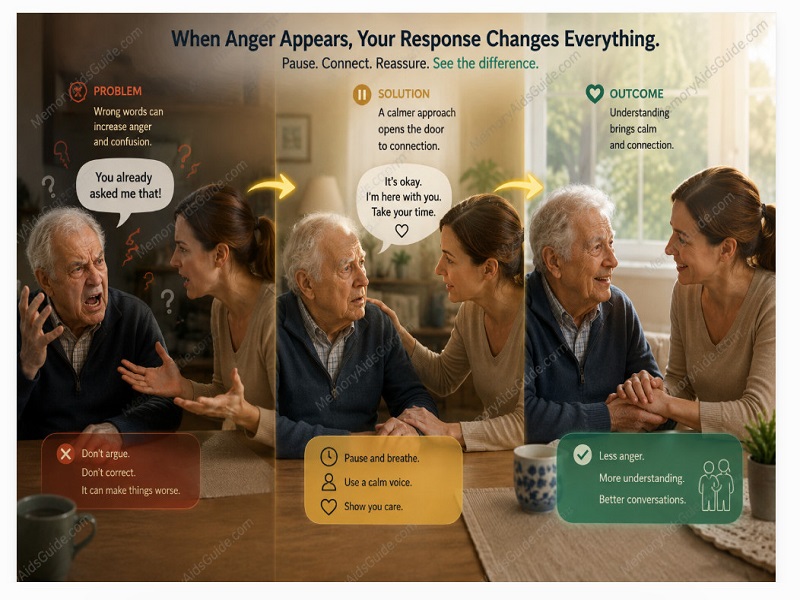
Use a calm voice. Listen. Give the person time to respond. Reassure them that they are safe and that you’re there to help. NIA recommends these approaches when dealing with agitation or aggression.
You might simply say:
“I can see you’re upset. I’m here with you.”
If talking isn’t helping, try changing the environment or gently redirecting their attention.
Knowing the 20 Things Not to Say to Someone With Dementia can be particularly helpful during these moments because communication mistakes can unintentionally increase fear, frustration, or anger.
If suspicion, accusations, or fear are becoming a regular part of the situation, see Dementia & Paranoia.
When the Same Question Keeps Coming Back
Before answering the same question for the fifth time, consider what may be underneath it.
Are they anxious about what’s happening next? Looking for reassurance? Confused about the time? Simply trying to connect?
A short answer may be enough. If the question keeps returning, a familiar activity can sometimes work better than another long explanation.
This is one practical example of why the 20 Things Not to Say to Someone With Dementia should be viewed as communication guidance rather than a rigid set of rules.
For more ideas, explore Memory Care Activities. And when everyday routines or remembering important information become harder, Memory Aids for Dementia may offer another form of practical support.
The Bottom Line
The 20 Things Not to Say to Someone With Dementia aren’t really about memorizing 20 forbidden sentences.
They’re about recognizing when a conversation is becoming a memory test, an argument, or unnecessary pressure.
The purpose of learning the 20 Things Not to Say to Someone With Dementia is not to become a perfect caregiver or communicator. It is to recognize communication mistakes and discover more respectful ways to respond.
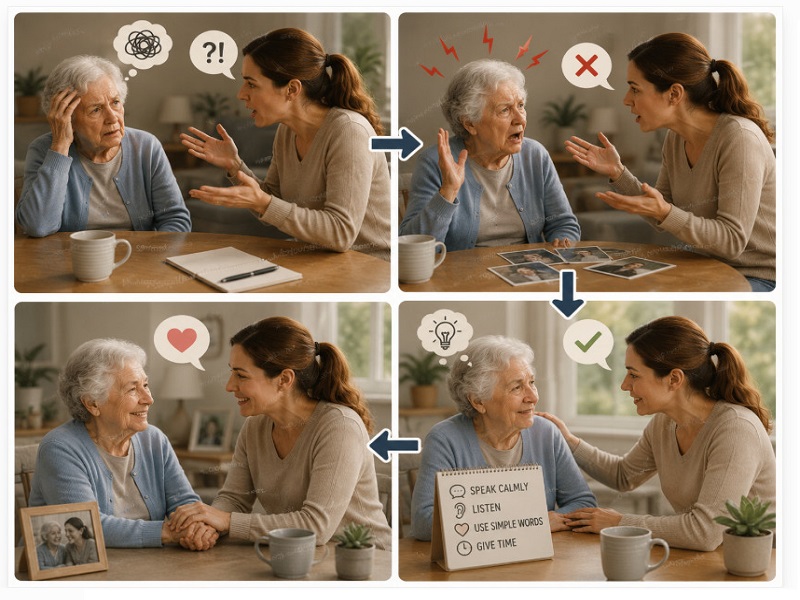
Pause before correcting. Listen before explaining. Reassure before arguing.
And remember that you’re human, too. You won’t respond perfectly every time.
No caregiver will remember all 20 Things Not to Say to Someone With Dementia perfectly in every difficult moment, and the goal is not perfection—it is learning, adjusting, and responding with greater patience over time.
What matters is what you do next: slow down, try again, and help the person feel respected, heard, and safe.
Looking Beyond the Conversation
Sometimes, communication changes are only one part of a larger concern about memory and mental clarity. Increasing forgetfulness, difficulty finding the right words, and moments of brain fog can leave people and families searching for answers long before they know exactly where to begin.
Understanding these changes can be a useful next step. If you’d like to explore this topic further, you can learn more here.